
Every creative idea starts as a static vision. A character design sketched on a tablet. A product photograph shot against a plain backdrop. A portrait captured in perfect lighting but frozen in a single expression. For years, the gap between these still moments and the dynamic videos they could become has been one of the most persistent frustrations in digital content creation. The image is there — compelling, polished, full of potential — but bridging it to motion has always meant stepping into an entirely different production world, one that most creators simply cannot access.
Traditionally, animating a still image required either frame-by-frame manual work in complex software, or professional motion capture equipment that costs thousands of dollars and demands a dedicated studio space. Even a short clip of a character walking or gesturing could take days of labor from a skilled animator. For independent creators, small studios, and businesses without production budgets, the message was clear: high-quality motion content belongs to those with resources. The rest had to settle for static images or visibly amateur animation that undermined the very professionalism they were trying to project.
That equation has shifted dramatically in the past two years. AI-powered motion control technology now enables creators to take a single still image — whether a character illustration, a product render, or a portrait photograph — and generate fluid, natural-looking video from it. The technology analyzes the structure of the source image, understands how its elements should move in three-dimensional space, and produces animation that respects the original style, lighting, and composition. What once required a studio, a team, and a budget now happens in a browser, often in minutes rather than days. This is not incremental improvement — it is a fundamental redefinition of who gets to create motion content and how quickly they can do it.
Understanding AI-Driven Motion Transfer
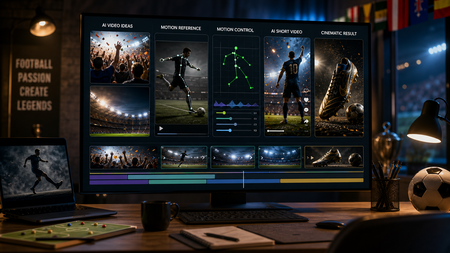
The core concept behind modern motion control is deceptively simple: provide a reference video containing the movement you want, and the AI transfers that motion onto your target image. A dancer’s performance can drive the animation of an illustrated character. A person nodding and speaking can bring a static portrait to conversational life. A sweeping camera pan across a landscape reference can add cinematic depth to a product shot that was captured with a stationary phone.
Beneath this simplicity, however, lies a sophisticated pipeline of neural processing. The system must first decompose the reference motion into its constituent parts — body pose, facial expression, hand articulation, and camera movement — each tracked through time with precision that rivals dedicated motion capture hardware. It then maps these motion vectors onto the target image, respecting the unique proportions, perspective, and stylistic characteristics of the source. A hand-drawn anime character has different joint relationships than a photorealistic human portrait, and the motion transfer must adapt accordingly without distorting either the movement or the visual identity of the original.
This is where approaches to kling motion control have made particular strides. Rather than treating motion transfer as a one-size-fits-all operation, modern implementations analyze both the reference and the target before deciding how to bridge them. The result is animation that preserves fine details — the way fabric folds during a turn, the subtle shift of facial muscles during speech, the natural sway of hair — without requiring the creator to specify any of these elements manually. For the first time, the technology is doing what previously only experienced animators could do: it understands that realistic motion is not just about moving from point A to point B, but about all the small secondary movements that make motion feel alive.
Advanced Character Animation and Full-Body Control
Moving beyond basic motion transfer, the real test of any motion control system is how it handles the human body in its full complexity. Hands have always been a notorious challenge in AI generation — too many degrees of freedom, too many possible configurations, too easy to get wrong in ways that viewers notice instantly. The same applies to facial expressions, where even minor inaccuracies in lip movement or eye direction can break the illusion of natural speech.
Traditional motion capture solved these problems with physical markers placed on an actor’s body and face, tracked by arrays of specialized cameras in controlled environments. The precision was high but the accessibility was near zero for anyone outside professional production circles. AI-based approaches have had to solve the same biomechanical challenges — tracking finger articulation from monocular video, maintaining consistent facial topology across head turns, preserving lip-sync accuracy when the reference audio doesn’t perfectly match the target face shape — without any of the physical infrastructure that makes traditional mocap reliable.
The progress here has been striking. Contemporary motion control systems can now track full-body movement including individual finger positions from a single reference video shot on a consumer smartphone. They maintain facial identity and expression consistency even when the head turns or tilts at extreme angles. Most impressively, they preserve lip-sync accuracy by analyzing both the audio track and the visual mouth shapes of the reference, then adapting that synchronization to the unique facial geometry of the target image. A character with a different jaw structure, lip thickness, or face shape than the reference speaker will still produce speech animation that looks natural rather than pasted-on.
What this means in practical terms is that a solo creator can now produce character animation that would have required a motion capture studio, a team of animators, and weeks of post-production just a few years ago. The gap between professional studio output and independent creator capability has narrowed not by inches but by orders of magnitude.
Specialized Applications Across Industries
The versatility of AI motion control extends far beyond character animation for entertainment. Across industries, the ability to generate controlled motion from still images is quietly reshaping workflows that have been stable for decades.
In e-commerce and product marketing, motion control enables a fundamentally different approach to visual content. A single product photograph — a pair of running shoes, a kitchen appliance, a piece of furniture — can be animated to show rotation, feature close-ups with dynamic camera movement, and contextual use scenarios, all from that one still capture. For small and medium businesses that cannot afford per-product video shoots, this capability transforms their visual marketing from static catalogs into dynamic showcases without multiplying their production costs.
In education and training, the technology addresses a persistent content bottleneck. Instructional materials often require demonstration videos that are expensive to produce and difficult to update. With motion control, a series of illustrated diagrams or photographed procedures can be converted into animated demonstrations. When the procedure changes, updating the source images regenerates the video without requiring a new shoot. Medical training, equipment operation guides, and safety procedure documentation all benefit from this flexibility.
In social media and content creation, the use case is perhaps most immediately visible. Creators who have built audiences around a particular visual style or character can now produce video content at the pace their platforms demand without sacrificing the quality their followers expect. A digital artist whose illustrated characters have gained a following can animate those exact characters — not approximations, but the same art the audience already loves — and publish video content on the same daily or weekly cadence that the algorithm rewards.
Across all these applications, the common thread is the removal of a bottleneck that creators have long accepted as inevitable: the assumption that motion content requires motion capture. That assumption is dissolving, and with it, the barrier that kept dynamic video production concentrated among those with the largest budgets and the most specialized teams.
Conclusion
Motion control technology has not replaced the creative eye — it has removed the technical scaffolding that once stood between a still image and the animation it could become. What required specialized hardware, dedicated studio space, and professional animation expertise is now accessible through a browser, driven by the same kind of reference video anyone can capture on their phone.
As these systems continue to improve — handling ever more complex motions, finer facial expressions, more nuanced camera work — the distinction between “professional animation” and “AI-assisted motion” will become increasingly meaningless. For independent creators, small studios, educators, and businesses, the tools to bring still images to life are already here. The only remaining step is to start experimenting with what becomes possible when every image in your library is also a potential video, waiting for motion to unlock what it was always meant to show.