
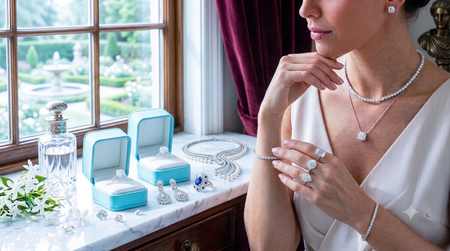
The New Visual Paradigm in Music Culture
In the contemporary music landscape, high-fidelity audio is only one half of an artist’s identity. We live in an undeniably visual era where an artist’s brand is forged as much through music video direction, album artwork, and editorial press shoots as it is through chord progressions and vocal delivery. From the neon-drenched aesthetic of indie synth-pop clips to the gritty, high-contrast framing of alternative rock visuals, the modern musician must command the lens with absolute authority.
Yet, for the independent artist, creative ambition frequently collides with production realities. Delivering a high-concept visual that competes with major-label budgets requires meticulous artistic discipline. Every element that enters the frame—from wardrobe selection and color grading to prop styling and fine adornments—must serve a deliberate, impactful purpose.
Recently, a quiet stylistic shift has begun rippling through green rooms, festival wardrobes, and video sets across the country. Independent tastemakers, creative directors, and indie artists are actively moving away from traditional, heavily marked-up commercial jewelry. Instead, they are crowning a new sovereign of visual performance: high-brilliance lab-grown moissanite. By combining unmatched optical physics with financial intelligence, this cosmic gemstone is empowering artists to deliver high-octane stage aesthetics without compromising their production budgets or ethical standards.
The Physics of the Stage: High Refraction Under 4K Lenses
To understand why visual directors are swapping traditional gemstones for modern moissanite on set, one must examine how camera sensors and cinematic lighting interact with physical matter. Under the punishing scrutiny of 4K digital cinema cameras, high-intensity LED rigs, and dynamic strobe arrays, inferior or poorly cut stones lose their luster, appearing milky, flat, or completely washed out in post-production.
True optical dominance requires extreme light manipulation. On a purely scientific level, a stone’s capacity to bend, refract, and bounce ambient light is dictated by its refractive index. While a traditional mined diamond carries a refractive index of 2.42, silicon carbide—gloriously known in fine jewelry circles as moissanite—boasts an extraordinary refractive index of 2.65 to 2.69.
“When you are designing a visual identity meant to perform under dynamic stage lights or high-definition camera setups, optical performance is the only metric that matters,” explains Ahmed Eid, gemstone specialist and founder of Moissanite shine. “Traditional mined stones rely heavily on artificial market scarcity to justify astronomical price tags, yet under intense venue lighting, moissanite actually outshines them. With a fire and dispersion rate more than double that of a traditional diamond, precision-cut moissanite grabs ambient light and shatters it into a mesmerizing multi-spectral rainbow fire. It is not an alternative or a compromise; it is a superior physical gemstone engineered for pure optical impact.”
For musicians performing under moody spotlighting, foggy venue atmospheric effects, or harsh outdoor festival sun, this heightened refraction ensures that every subtle movement translates into an electric burst of light on camera.
Mic Drops and Fretboard Close-Ups: Framing the Hands
In music video cinematography, the hands are central storytellers. Directors frequently rely on tight macro shots to capture the raw emotion of an artist’s performance—a guitarist’s fingers flying across a fretboard, a pianist navigating an intricate run, or a vocalist gripping a vintage condenser microphone. These close-up moments demand focal points that draw the audience’s eye without cluttering the frame.
Adorning the hands with high-impact pieces creates a compelling visual dynamic. When an artist incorporates brilliantly handcrafted Moissanite rings into their performance wardrobe, they instantly anchor the frame with a commanding, high-carat presence.
Whether selected as a bold, solitaire statement piece that catches the lens during a guitar solo or stacked in layered, geometric bands to complement an edgy streetwear aesthetic, the stone’s intense dispersion adds dynamic texture to every gesture. Because these gems are cut with exact facet symmetry and pavilion precision, they maintain absolute clarity even under heavy color gels and low-light cinematic filters. The result is a crisp, polished visual anchor that elevates a simple hand movement into a cinematic statement.
Framing the Vocalist: The Power of Upper-Body Illumination
While statement rings captivate during instrumental close-ups, framing the face remains the primary objective during vocal performances. Portrait lighting in music videos is designed to highlight facial expressions, draw focus to the vocalist’s eyes, and create a distinct separation between the artist and the background set design.
Celebrity stylists and visual directors understand that face-framing accessories act as human reflectors. Incorporating light-catching Moissanite Earrings into an artist’s wardrobe provides a subtle yet transformative lighting effect. Positioned directly alongside the jawline and cheekbones, high-refraction studs or dramatic cascading drop earrings catch ambient venue lighting and bounce illumination directly onto the face.
This technique creates a natural, cinematic glow that softens facial features and adds a layer of high-end polish to the vocal performance. From crisp, minimalist studs that provide sharp daytime elegance during acoustic sessions to bold, architectural drops that capture the erratic flashes of live stage strobe lights, these pieces ensure the singer remains the undisputed focal point of every shot.
Fluid Motion on Stage: The Moissanite Tennis Bracelet
While rings and earrings establish the primary visual anchors, achieving a truly cohesive, red-carpet-worthy stage look requires addressing the fluid motion of the wrists. A frequent aesthetic oversight in music video styling is a disconnect between high-brilliance focal points on the face and bare, unadorned arms—particularly when an artist is gesturing dynamically or playing percussion instruments.
Enter the timeless revival of the tennis bracelet. Characterized by a continuous, unbroken line of individually set, high-refraction gems, a moissanite tennis bracelet introduces a liquid-fire movement that flows naturally with the artist’s choreography. As a drummer strikes a cymbal or a lead singer reaches out toward a festival crowd, the articulated links flex along the wrist, catching ambient venue lights from every conceivable angle. Stylists frequently stack multiple widths—pairing a heavy 5mm bezel-set bracelet with a sleeker prong setting—or layer them alongside vintage timepieces to build a rich, multi-dimensional texture that looks effortlessly cool on camera.
Neckline Architecture: Pendants and Layered Chains
To complete the artist’s visual ensemble, attention must be directed toward the neckline. Necklaces serve a vital structural function in film and photography; they bridge the visual gap between face-framing earrings and hand accessories, establishing a balanced central axis for the entire outfit.
In contemporary performance styling, the art of layered neckwear has become a defining trend. Musicians are increasingly bypassing simple, single-strand chains in favor of dramatic, multi-length combinations. Pairing a choker-length moissanite tennis collar with a longer, low-slung pendant featuring a large geometric cut—such as a sharp emerald cut, a vintage Asscher, or an elongated oval—creates a cascading waterfall of light against dark velvet blazers, unbuttoned silk shirts, or high-concept streetwear hoodies. Because high-refraction moissanite eliminates the exorbitant carat-weight costs associated with legacy mined stones, artists can boldly experiment with larger, bolder pendant scales that command the screen without overwhelming their wardrobe silhouettes.
Smart Luxury: Reinvesting Capital Into the Music
Beyond the physical beauty and technical optics, the turn toward modern moissanite is driven by a profound cultural shift in how independent creators view financial capital. The contemporary music industry requires artists to operate as smart, disciplined entrepreneurs. Every dollar spent on inflated retail markups or legacy commercial status symbols is a dollar diverted away from album production, mixing and mastering, vinyl pressing, tour logistics, or targeted PR campaigns.
Choosing “Smart Luxury” is an assertive declaration of modern independence. True prestige is no longer measured by how much capital was arbitrarily expended at a legacy retail counter—it is measured by how intelligently that capital was deployed. By choosing high-brilliance, ethically synthesized gemstones, artists achieve the exact same—if not scientifically superior—aesthetic presence on stage while retaining substantial capital to fund their creative independence.
Furthermore, moissanite offers non-negotiable physical permanence for artists constantly on the road. Registering a 9.25 on the Mohs scale of mineral hardness, it is second only to diamond in scratch resistance, far outclassing fragile glass simulants or cubic zirconia that cloud, scratch, and degrade after a few performances. Set in heavy, tarnish-proof sterling silver, solid gold, or dense platinum-plated mountings, these pieces are engineered to endure the physical rigors of touring, stage sweat, and constant travel luggage packing.
Owning the Spotlight on Your Own Terms
As music culture continues to evolve, the boundaries between high fashion, stage performance, and independent artistic integrity have merged. The modern artist understands that building an unforgettable brand is not about following an outdated corporate playbook or incurring crippling debt for the sake of appearance.
True glamour is forged through individuality, conscious choices, and an uncompromising eye for quality. By pairing cutting-edge optical science with heavy metallurgical craftsmanship, independent musicians are taking control of their visual narrative. From the fiery sparkle of face-framing accents under stage LEDs to the fluid movement of tennis bracelets along the wrist and the commanding presence of high-carat rings on the fretboard, the tools for sculpting an iconic, camera-ready aesthetic are finally within reach—allowing artists to shine brighter, live responsibly, and own the spotlight entirely on their own terms.