
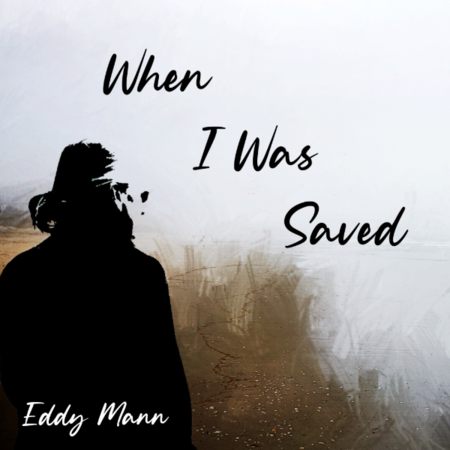
There are songs that try to explain faith, and then there are songs that walk straight into the fire and come out carrying something scorched, trembling, and real. Eddy Mann’s “When I Was Saved” doesn’t just dip a toe into gospel waters—it wades waist-deep into blood, dust, and revelation, and dares you to follow.
Let’s get something straight: this isn’t your polished, plastic Sunday morning singalong. There’s no slick, arena-ready crescendo designed to make you raise your hands on cue. What Mann delivers instead is something far more unsettling—a slow-burning, introspective reckoning with the moment Christianity hinges on. And he does it with a line that hits like a hammer to the ribs: “I was saved the day my best friend died.”
That’s not just a lyric. That’s a confrontation.
Musically, the track lingers somewhere between folk confession and roots-rock restraint. It’s stripped down, almost stubbornly so. Acoustic guitars hum like they’ve been sitting in a pew too long, the rhythm section barely rises above a heartbeat, and everything feels like it’s been deliberately dialed back so the weight of the words can settle in your bones. No gloss, no gimmicks—just space. And in that space, Mann builds tension the old-fashioned way: patience.
His voice isn’t trying to overpower you. It’s weathered, human, a little worn around the edges—and that’s exactly why it works. He sounds like a guy who’s lived with these questions, not just someone reciting them. There’s grit in the delivery, but also restraint, like he knows the story he’s telling is bigger than anything he could dress up with vocal theatrics.
https://open.spotify.com/track/4fP6v4f227vaWGrCD9B6HC?si=2cbc1bed9a39470d
And then there’s Liz Collins, whose backing vocals drift in like a ghost at the edge of the frame. She doesn’t steal the spotlight—she haunts it. Her presence adds a kind of spiritual tension, like something unseen is pressing just beneath the surface of the track, waiting to break through.
But what really makes “When I Was Saved” land is its refusal to sanitize the crucifixion. Mann doesn’t tidy it up into a neat theological package. He leans into the confusion, the cruelty, the raw contradiction of it all—mockery and mercy colliding in real time. You can almost feel the sky darkening, the crowd shifting, the weight of something irreversible happening.
This is faith music that doesn’t flinch.
And maybe that’s the point. Because the story of the cross isn’t supposed to be comfortable. It’s supposed to shake you, to crack something open. Mann seems to understand that in a way a lot of contemporary Christian music politely sidesteps.
“When I Was Saved” isn’t trying to convert you with volume or spectacle. It’s doing something riskier—it’s asking you to sit still and feel it.
And in 2026, that might be the most rebellious thing a song about faith can do.
–Leslie Banks