
By Leslie Banks
There are love songs, there are lust songs, and then there are songs that sound like somebody kicked open the medicine cabinet, swallowed the whole damn pharmacy, and decided romance was the only antidote left.
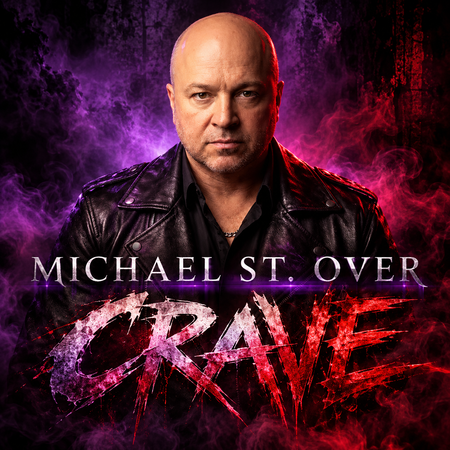
Michael St. Over’s “Crave” belongs to that third category.
This isn’t candlelight and roses. It isn’t polite longing delivered over tasteful acoustic guitar while somebody stares meaningfully through a rain-streaked window. “Crave” is about desire as addiction—the kind that rattles your bones, hijacks your common sense, and leaves you wondering whether the thing keeping you alive might also be slowly killing you.
Which, when you think about it, is about as rock ’n’ roll as romance gets.
From the opening declaration—“I was born to love you baby / You were born to drive me crazy”—St. Over dispenses with subtlety. Good. Rock music has spent far too many years apologizing for wanting something. “Crave” doesn’t apologize. It grabs desire by the collar and drags it straight into the spotlight.
The song’s central metaphor is gloriously excessive: love as drug, lover as addiction, passion as monkey-on-your-back compulsion. St. Over sings about needing another person like a fix, and the language is intentionally dangerous. This isn’t some soft-focus Hallmark version of devotion. It’s bodily. Desperate. Slightly unhealthy. Maybe very unhealthy.
And that’s precisely why it works.
Great rock songs have rarely been instruction manuals for sensible living. Chuck Berry wasn’t writing tax advice. The Stones didn’t build a career around emotional moderation. Rock ’n’ roll is supposed to exaggerate feelings until they become enormous enough to shake the speakers.
“Crave” understands that.
Musically, St. Over plants the song firmly in muscular modern rock territory, built around an immediate hook and the kind of chorus designed to stick after one pass. The lead and rhythm guitars give the track its bite, while St. Over handles the vocals himself. There’s a satisfying self-contained quality to the recording—less committee-built product, more somebody locking themselves in a room until the thing in their head finally comes roaring out.
The chorus is where the song earns its title. “Your love’s a drug I jones to take,” St. Over sings, doubling down on imagery that would collapse under its own weight if he delivered it timidly. He doesn’t. The performance sells the obsession because there’s conviction behind it.
Then comes the bridge, where the craving gets even more physical: skin, breath, touch, proximity. By this point the song has stopped pretending love is primarily an intellectual exercise.
Thank God.
There’s something refreshingly unfashionable about “Crave.” It believes in big emotion. It believes guitars should sound like guitars. It believes a chorus ought to announce itself instead of politely requesting admission.
Most importantly, it believes desire should feel dangerous.
Maybe that’s the secret hiding underneath all the addiction metaphors. “Crave” isn’t really celebrating dependency. It’s describing that terrifying moment when another human being gets close enough to become necessary.
That’s romance without the greeting card.
That’s obsession plugged into an amplifier.
And that’s rock ’n’ roll.
Reduce repeated addiction imageryReplace the placeholder byline
Pre-save “Crave” at http://tunelink.to/michael-st-over_crave