
How live streaming turned music into paid participation, why the Presence Premium matters, and what artists should build next.
Picture a songwriter going live with a half-finished chorus and 37 people in the room.
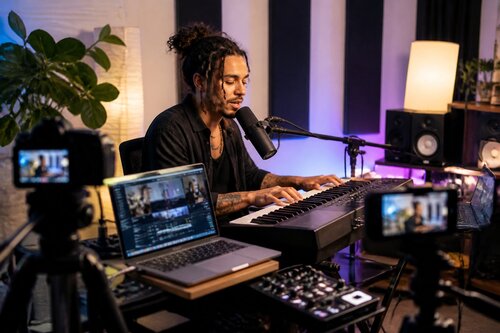
One viewer suggests a lyric change. Another sends a tip to hear the slower version. Someone who joined last week gets named on-screen when the bridge finally works. The performance is not valuable because it looks like a concert. It is valuable because the audience can affect what happens before the song is finished.
This pattern, presence, recognition, influence, return, is where sustainable livestream monetization starts. The artists who understand it stop asking, “How do I make this stream look like a show?” and start asking, “What can only happen because this is live?”
What happens when fans can shape a song in real time?
Live streaming has moved music from polished recorded products to recurring, participatory presence. Fans pay to be seen, influence songs, and return regularly. That pattern raises per-fan revenue and shifts artist strategy toward consistent streams, repeatable rituals, and subscription-style access.
- Presence replaces perfection: engagement beats peak viewer counts
- Micro-payments and virtual tipping drive recurring fan revenue
- Platform risk and repeatable cadence shape what comes next
I study creator economies and advise musicians on subscription and livestream strategies.
Key Takeaways
- Artists should design live streams around repeatable rituals, tiered access, and small monetizable interactions.
- The Presence Premium is the additional revenue artists earn when fans pay to be present, visible, and involved in a live stream, not just to listen.
- The Live-to-Library process involves streaming early-stage work, co-creating with viewers, converting attention into sales, and archiving select content for ongoing revenue.
- Consistent, low-stakes presence builds viewer habit faster than occasional high-production events.
- The strongest moments to place a call to action are after a creative segment, at the peak of an event launch, and as a standing offer in a pinned channel description.
- Artists who master the Presence Premium can capture a larger share of fan spending than recorded audio alone.
From star power to the Presence Premium
Traditional industry thinking prizes distance and myth-making. The live-stream economy prizes access, routine, and repeated shared moments. The money moves in the gap between those two models, and that gap is what we call the Presence Premium: the additional revenue artists capture when fans pay not just to listen, but to be seen, heard, and involved.
Recorded music sells a finished object. A live stream sells a shared moment. That distinction matters because finished objects compete on abundance, while shared moments compete on belonging.
Independent artists are already proving this out. Fans use virtual tipping on platforms like Twitch and YouTube Live to nudge a bridge chord, subscribe on Patreon to watch a track being built from scratch, and return weekly because they got named on screen during the session. That kind of involvement is hard to replicate with a studio release because the value is not only in the song. It is in the proof that the fan was there while the song was becoming itself.
Fixed time slots, on-air recognition, and simple subscription tiers convert casual viewers into recurring supporters more reliably than any playlist pitch because they create habit. According to a live-streaming industry report from Stream Hatchet live gifting and livestream monetization have grown consistently year over year, a clear sign that fans now expect active involvement, not just passive performance.
Plenty of artists still chase peak viewer counts. That’s the wrong metric. Engagement frequency and real-time interaction are far better indicators of long-term revenue. A stream with 40 regulars who tip, make requests, and subscribe is worth considerably more than a viral moment that never converts. The useful question is not “How many people watched?” It is “How many people felt involved enough to come back?”
This is the first uncomfortable lesson of live streaming culture: attention is not the asset. Returning attention is the asset.
The Live-to-Library Process
Once live streaming is treated as participation rather than broadcast, the next question becomes practical: how does an artist turn an ordinary session into something that keeps earning? The answer is not to make every stream precious. It is to build a repeatable path from unfinished work to fan involvement to archived value.
- The Raw Rehearsal. Stream early-stage work. Fans enjoy being part of the creative process and will tip or subscribe to influence it. Early access is far more monetizable than most musicians assume because unfinished work creates room for the viewer to matter. Example: stream a half-finished demo and ask viewers to vote on one lyric line.
- The Interactive Build. Use chat, polls, and requests to co-create. Small choices, picking a bridge or voting on a lyric, produce outsized engagement and repeated micro-payments because viewers have real skin in the game. The choice does not have to be artistically massive. It only has to be visible enough that the viewer can recognize their influence later. Example: run a live poll between two chord progressions and credit contributors by name in the final recording.
- The Event Launch. Convert peak attention into sales. Ticketed streams, limited digital items, or timed merch drops land well when they feel like a community moment rather than a push notification. This works best when the launch feels like the natural climax of a shared process, not a commercial interruption. Example: announce a 48-hour merch window exclusively to viewers watching the stream live.
- The Evergreen Archive. Keep select streams behind a supporter tier, or repurpose clips into a searchable live-to-library. Done consistently, this turns a one-time broadcast into ongoing revenue without producing new content from scratch. The constraint is that raw live footage often needs context, titles, trimming, and framing before it works for someone who was not there live. Example: clip the co-writing segment and pin it as a teaser to drive tier sign-ups.
The practical bottleneck in the Live-to-Library process is not content volume. It is deciding which moments deserve to survive after the room has emptied. Not every stream should become an archive, and not every intimate moment should be repackaged. Scarcity still matters, even in an always-on format.
Programming Your Streams: Building the Habit
If you’re just starting out, set a fixed weekly Studio Hang, work in view, and narrate the process rather than performing polished shows. Regular, low-stakes presence builds viewer habit faster than occasional high-production events. A consistent schedule trains your audience to show up, and showing up is where livestream monetization actually takes root.
This feels backwards to many musicians. They assume the show should be impressive before it becomes frequent. What usually happens is that frequency teaches the audience how to behave. The first few streams are not just content, they are training sessions for the community: when to arrive, how to request, when to tip, what kind of participation is welcome, and what kind is not.
The three platforms where fan monetization is most active each reward this differently. Twitch is built around subscription tiers and channel points making it well suited to repeat-viewer routines and paid-request slots. rewards short, high-energy interactions that convert new followers into tippers quickly, useful for independent artists still building an audience. YouTube Live offers, working especially well for artists who already have a subscriber base and want to layer paid access on top of an existing catalog.
The platform choice should follow the artist’s natural rhythm, not the other way around. A songwriter who thrives in long conversations may feel cramped on a short-form discovery feed. A performer with quick hooks and high-energy audience prompts may find Twitch too slow at first. The right platform is the one where the artist can repeat the same core ritual without resenting it after a month.
Once the routine is established, structure each stream around monetizable moments: short creative segments, Q&A, paid-request slots, and custom sound alerts tied to virtual tipping.
A lot of independent artists obsess over their setup while ignoring that loop entirely. A predictable watch-react-tip-acknowledgment cycle improves retention more reliably than production value alone. Getting the loop right matters more than buying better gear because the audience remembers being acknowledged long after they forget whether the camera was perfect.
During longer sessions, drop a brief call to action roughly every 10–15 minutes. Something like “Jump into the supporter tier if you want to pick next week’s track” keeps the on-ramp frictionless and stops attention from quietly drifting.
A common early pattern is spending weeks refining overlays, lighting, and transitions before viewers are ever asked to participate. The stream can look finished and still feel inert. The overlay is not the experience. The loop is the experience.
Common mistakes that kill momentum
The silent stream. Playing music without talking to chat signals that you value performance over connection. Fans showed up for the interaction. Silence turns a stream into background noise, and background noise doesn’t convert. The room may still be live, but it no longer feels alive.
The high-production trap. Waiting for a multi-camera studio setup before going live. A candid phone session often builds community faster than a polished one-off. Upgrade once your routine and demand are proven, not before. Better gear can improve a working ritual, but it rarely creates one from nothing.
The artists who struggle most aren’t always the least technical. They’re often the ones who feel they need everything perfect first, and that instinct works against them almost every time. Live streaming rewards responsiveness. Perfection, when it delays contact, becomes a form of avoidance.
The one-and-done schedule. Streaming once a month and expecting a community to form. Inconsistent scheduling trains fans to treat you as occasional entertainment rather than a regular touchpoint worth returning to. The audience cannot build a habit around a moving target.
A few other patterns come up repeatedly that platform guides rarely mention:
- Chat engagement drops sharply if you go longer than around 20 minutes without acknowledging a specific viewer by name. Generic shoutouts don’t carry the same weight because they do not confirm that any one person was actually seen.
- Timed merch drops work, but only if the audience genuinely feels like they’re getting early access. Announce the same drop on social media first and the exclusivity falls apart entirely.
- Clip repurposing sounds effortless in theory. In practice, most live footage needs more editing than expected before it works as standalone content. Raw streams rarely cut cleanly without some trimming.
- Platform recommendation algorithms behave differently during live sessions than with on-demand content. What grows a VOD channel doesn’t necessarily grow a live presence, even on the same platform.
None of this is insurmountable, but the first few months rarely look like the plan. The practical goal is not to optimize everything. It is to find one repeatable interaction viewers understand immediately, then build around it.
Editorial policy
This article was researched independently. No platform or operator paid for placement or editorial coverage.
Where conversion fits naturally
The strongest moments to place a call to action are after a substantial creative segment, at the peak of an event launch, and as a standing offer in your pinned channel description. Each moment shares one quality: the viewer has already invested time and attention, so the ask feels earned rather than forced.
That distinction is easy to miss. A bad conversion moment asks the viewer to pay before they feel connected. A good one gives them a reason to continue a feeling they already have. The sale works because it extends participation, not because it interrupts the stream with urgency.
Keep the offer simple. One low-friction option, a tip, a one-off paid chat, or a monthly supporter tier, converts better than a menu of choices. Peer-to-peer language works best. “Jump into the supporter tier if you want to pick next week’s track” outperforms any formal pitch. Name the benefit, make the action obvious, and limit yourself to one ask per session segment.
Platforms like Bandcamp, Patreon, and Ko-fi integrate cleanly with most live streaming setups, giving independent artists a direct route to fan support without relying on platform revenue shares alone. Pinning a link in your stream description takes thirty seconds and removes the friction for viewers who are ready to support but won’t go searching for a way to do it.
Every new monetization route adds another thing to explain, moderate, fulfill, or maintain. A simple supporter tier that reliably matches the stream ritual is usually stronger than five scattered links that confuse viewers. Monetization should feel like a door, not a maze.
When viewers feel like participants rather than an audience, revenue tends to follow. That shift in dynamic, from listener to stakeholder, is the whole point of real-time engagement.
What comes next: the Presence Premium in music and beyond
Live streaming’s commercial logic didn’t stay contained within the music industry. Independent artists, comedians, fitness coaches, and educators have all landed on the same core mechanics: subscription tiers, real-time recognition, micro-payment triggers. The underlying pattern holds across all of them. When exclusive access is rewarded and recognition is immediate, presence converts into revenue in ways recorded content simply can’t replicate.
The same participation-first model has also reshaped other creator industries, including live streaming categories where interaction is central to the experience. Independent resources such as Chatterbate analyse how real-time engagement, audience participation and live creator communities continue to evolve across interactive streaming.
That’s worth sitting with. It’s not just that live streaming earns differently, it earns differently because the product has changed. The product is not only the lesson, set, song, or workout. It is the social proof of being present while something unfolded.
Fan spending per head tends to run higher among audiences who show up regularly for a stream than among passive listeners. The has illustrated this at scale, showing steady year-over-year growth in live gifting across categories. Virtual tipping is becoming a durable revenue line, not a novelty, and for independent artists especially, that shift matters.
For musicians and their managers, the implication is strategic. Artists who master this dynamic aren’t just monetizing streams. They’re selling rehearsal seats, creative influence, and social capital, capturing a larger share of fan spending than recorded audio alone ever could. Platforms like Twitch, YouTube Live, and TikTok Live each offer different monetization structures, and tools such as StreamElements or Fourthwall can help artists consolidate merch, tipping, and memberships into a single ecosystem.
The opportunity comes with real trade-offs. Platform algorithms shift without warning, and discoverability for livestreams on any single platform can erode overnight. Gift policies, revenue-share terms, and payout thresholds have all changed in recent years across Twitch, TikTok Live, and YouTube, and what works today may not hold next year.
Community moderation becomes a genuine overhead cost as audiences grow. A stream without it can sour quickly, damaging trust that took months to build. Many artists do not anticipate the management burden until they’re already deep in it, spending more time policing chat and handling disputes than actually performing.
Burnout is equally real. Artists who stream four or five times a week often hit a revenue plateau while the creative and time costs keep climbing. Sustainable cadence beats maximum frequency almost every time. The point is not to be permanently available. It is to be reliably present.
Three near-term shifts are likely to shape how this plays out over the next two to five years:
- Better creator tools for recurring revenue, more refined tipping mechanics and subscription features across major platforms
- Hybrid live and touring models, artists combining a regular streaming presence with selective in-person shows to protect bandwidth and diversify income
- Greater discovery friction on dominant platforms, as livestream content grows, algorithmic discoverability may tighten, making owned audiences more valuable
Early AR/VR concert experiments are also underway, though mass adoption remains a few years out. Platform-policy risk and revenue-share volatility are the variables most likely to force strategic pivots in the near term.
The artists experimenting with this format now, before competition hardens and the mechanics get picked over, are the ones most likely to define what fan relationships look like next. But this is not for every musician. Artists who dislike real-time interaction, need long creative privacy, or cannot maintain a regular cadence may be better served by recorded releases, touring, licensing, or direct patronage models that do not require constant presence.
For artists who do have the temperament for it, the next step is not a bigger production budget. Start with one weekly ritual, one clear supporter offer, and one repeatable way for viewers to influence what happens on screen. Build with a clear-eyed view of platform risk and personal bandwidth, and the format becomes less of an exhausting sprint and more of a durable audience practice.
Editorial policy
This article was researched independently using publicly available industry data, platform documentation, and third-party reporting. No platform or operator paid for placement or editorial influence.
Frequently Asked Questions
How has live streaming changed the music industry, and what comes next?
Live streaming shifted music’s value model away from polished recordings toward recurring, participatory presence. Fans pay to show up, get recognized, and influence what happens in real time. Independent artists who build that rhythm can monetize through subscription tiers, virtual tipping, and paid access. What comes next: deeper platform integration, early AR/VR experiments, and real-time engagement becoming a primary revenue channel in its own right.
What is the Presence Premium?
The Presence Premium is the extra revenue an artist earns when fans pay not just to listen, but to show up and share a live moment. It’s the financial value of shared experience over finished product: recognition, influence, and belonging layered on top of the music itself. For many independent artists, it can become a more dependable income layer than recorded-streaming payouts alone.
What are the steps of the Live-to-Library process?
The Live-to-Library process has four stages: Raw Rehearsal, Interactive Build, Event Launch, and Evergreen Archive. A practical example is streaming a demo, letting chat vote on a lyric, launching a limited item during the finished performance, then clipping the co-writing moment for a supporter tier.
Which platforms work best for musician monetization through live streaming?
Twitch suits artists who want as their core fan monetization model. TikTok Live works well for short, high-energy sessions where drive micro-revenue from casual viewers. YouTube Live fits artists with an existing subscriber base who want to layer in paid access and Super Chats over time.
What are the most common mistakes artists make with live streaming?
The most common pitfalls are silent streams, the high-production trap, and an inconsistent schedule. Treat those as warning signs. If nobody is being acknowledged, no recurring ritual is forming, and the artist keeps postponing the next session until it looks perfect, the stream is unlikely to build revenue momentum.
What can I realistically expect from ritualized streaming as an independent artist?
Expect modest income for the first several months. Real audience relationships take repeated weeks of consistent on-air presence to develop. Start with one weekly session, one clear supporter offer, and one way for viewers to influence the stream before adding more platforms or production complexity.