
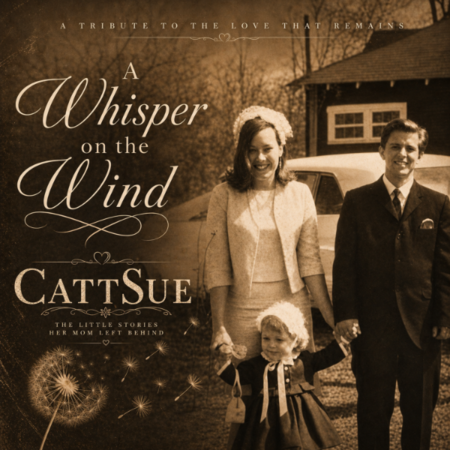
Some songs are heard. Others are felt somewhere deeper — in that hidden chamber of memory where old photographs fade at the corners, childhood echoes still linger, and the people we lost never quite leave us. CattSue’s “A Whisper on the Wind” belongs to that second category. It’s not chasing trends, algorithms, or Nashville polish. It’s chasing something far more elusive: emotional truth.
And it catches it.
From the very first lines, CattSue opens the door to a deeply personal story rooted in the loss of her mother at just four-and-a-half years old. Heavy stuff, right? But here’s where the magic happens: she doesn’t turn grief into spectacle. There are no overblown vocal gymnastics, no dramatic orchestral swells screaming, “Feel this!” Instead, she leans into restraint — and that’s what makes the song hit like a freight train at midnight.
The image of little CattSue carrying her Mrs. Beasley doll everywhere after her mother passed away? That’s not songwriting-by-numbers. That’s lived experience. It’s painfully specific in the best way. You can see the child. You can feel the confusion. You can almost hear the silence inside the room after everyone else stopped talking about the loss because they assumed time would somehow fix it.
Spoiler alert: it doesn’t.
Musically, “A Whisper on the Wind” drifts in this beautifully understated lane between contemporary country, acoustic pop, and singer-songwriter confession. The production is warm, spacious, and intimate — the kind of arrangement that knows when to step back and let the lyric breathe. No unnecessary clutter. No shiny distractions. Just atmosphere wrapped around emotion.
And CattSue’s voice? That’s the secret weapon here.
There’s a tenderness in her delivery that never feels performative. She sings like someone reading pages from a private journal they never intended anyone else to see. Every phrase carries weight because she isn’t trying to impress you — she’s trying to connect with you. Big difference.
The chorus lands with quiet devastation:
“You’re my beautiful angel
Watching from above
I only had a little time
But it was enough…”
That line — “But it was enough” — says everything. Most songs about loss focus on what was taken away. CattSue focuses on what remains. Love. Presence. Connection. The invisible threads tying memory to everyday life. That emotional pivot transforms the song from sadness into healing.
And then comes the bridge — easily the emotional centerpiece of the track.
“I wish I could remember the sound of your voice…”
Wow.
Anybody who has lost someone too young understands exactly what that line means. The terror isn’t only losing the person. It’s losing the details. The voice. The laugh. The tiny things memory slowly erases over time. CattSue taps into that universal fear with startling honesty.
But instead of leaving the wound open, she fills the silence with imagined comfort: “My girl, I’m proud of you — go chase your dreams.”
That moment doesn’t feel manufactured. It feels necessary. Like she spent years needing to hear those words and finally gave herself permission to believe them.
There’s something refreshingly fearless about “A Whisper on the Wind.” In a music culture obsessed with hooks, image, and instant gratification, CattSue slows everything down and asks listeners to sit still with emotion. That takes guts.
Following the chart success of her debut single “Come Home to Me,” including recognition on the UK iTunes charts and Independent Music Network rankings, CattSue could’ve easily chased a safer, more commercial follow-up. Instead, she delivered the most personal song of her life.
That choice matters.
Because “A Whisper on the Wind” isn’t just another sad song. It’s a conversation between past and present. Between a little girl searching for answers and a grown woman finally finding peace in the unanswered spaces.
And somewhere in that stillness, CattSue creates something rare: a song that doesn’t just sound beautiful — it heals quietly while you’re listening.
–Lonnie Nabors