
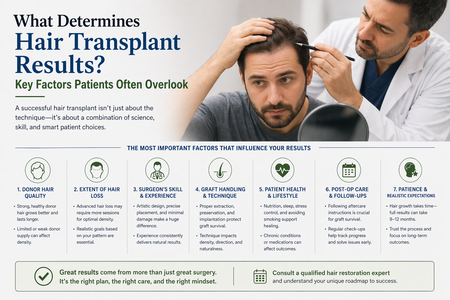
Two patients walk out of two clinics with a similar graft count, similar recovery timelines, and comparable starting conditions. A year later, one has a natural, dense, undetectable restoration. The other has something visibly off, density that feels wrong, direction that fights the natural grain, a hairline that looks drawn rather than grown.
The difference rarely sits in the technique name printed on the brochure. It sits in a set of factors that most patients don’t think to ask about until after the procedure, when it’s too late to influence them.
1. The Surgeon’s Actual Involvement
In high-volume clinics, the surgeon you consult with is often not the person performing the critical steps of your procedure. Technicians extract follicles. Technicians place them. The surgeon floats between rooms, supervising multiple cases at once.
This model works at scale. It doesn’t produce the best aesthetic outcomes. Hairline design, graft orientation, and density gradient are creative and technical decisions made in real time, and they are only as good as the hands making them. Specialists at Kibo Clinics have built a deliberate counter-model around this point, with transparency about exactly who performs which step. The difference in outcomes, over the long run, is visible.
2. Donor Quality, Not Just Donor Quantity
Patients and clinics both tend to talk about donor areas in terms of graft count. Five thousand available. Seven thousand available. The number matters, but so does the quality of each follicular unit, hair shaft diameter, follicular grouping, pigment, and the angle at which the hair exits the scalp.
A scalp with four thousand high-quality, multi-hair follicular units can produce denser, more natural coverage than a scalp with six thousand lower-quality single-hair units. The visual impact per graft is not uniform. A good consultation will assess quality, not just count, and factor that into the restoration plan.
3. The Hairline Design
This is the single most artistic decision in a hair transplant. A hairline isn’t a straight line; it’s a subtle, irregular zone with density gradients, tiny asymmetries, and variation in graft types along its length. The first row should consist of single-hair follicles placed at soft, natural angles. The density should build progressively behind it.
Clinics that design hairlines too low, too straight, or too dense, a common mistake in patients who insist on mimicking their hairline from age sixteen, produce results that age poorly. A natural hairline at thirty-five should look like a natural hairline at thirty-five, not at fifteen.
4. Graft Handling Between Extraction and Placement
Follicles are fragile. Between the moment they leave the donor zone and the moment they are placed into the recipient site, they are exposed to time, temperature, mechanical stress, and dehydration risk. Every minute and every millilitre of handling quality matters.
Clinics with careful protocols, chilled holding solutions, minimised out-of-body time, gentle handling with appropriate instruments, precision-placement techniques, see meaningfully higher graft survival than clinics that treat this stage as routine. Graft survival translates directly to the density you see a year later.
5. Recipient Site Creation
The creation of recipient sites, the small incisions into which grafts are placed, determines angle, depth, and density. Done well, recipient sites respect the natural direction of hair growth across every zone of the scalp, which shifts subtly from the frontal hairline to the crown. Done poorly, recipient sites produce hair that grows straight out of the scalp like bristles.
This step, more than any other, separates a natural-looking result from an obviously artificial one. It is entirely a function of clinician skill.
6. Post-Operative Care and the 12-Month Journey
The procedure ends in a day. The result takes a year.
Patients who follow structured aftercare, proper washing protocols, sleep positioning, gradual return to exercise, avoidance of direct sun, and supported medical management of the underlying hair loss condition, consistently produce better outcomes than patients who treat the procedure as a finish line.
The shedding phase at weeks two to four is normal. Growth begins around month three. Meaningful thickening arrives between months six and nine. Final assessment happens at twelve months. Skipping parts of this journey, or panicking through them, compromises results in ways that are entirely preventable.
7. Management of Surrounding Native Hair
A transplant moves resistant follicles into vulnerable zones. The native hair around those transplanted follicles continues to behave according to the patient’s underlying genetics. Without parallel medical management, native hair can continue to thin around a dense transplanted zone, producing results that look increasingly unnatural over time.
This is why transplantation is best thought of as part of a plan, not a standalone event. The plan includes the surgery, the surgery’s recovery, and the long-term protection of everything that wasn’t transplanted.
Expert Tip
Ask any clinic to show you their own results at the twelve-month mark, not week four, not month three, but month twelve, photographed under standard lighting from multiple angles. A clinic comfortable showing its own long-term outcomes is usually a clinic with long-term outcomes worth showing.
The Honest Takeaway
Hair transplant outcomes are shaped by dozens of small decisions, most of which happen long before and long after the day of the procedure itself. The technique matters. The hands matter more. And the plan around the procedure, design, graft handling, aftercare, and ongoing management of the rest of your scalp, matters most of all. Choosing well on these factors is the single biggest lever a patient has over how their restoration looks in five, ten, and twenty years.