
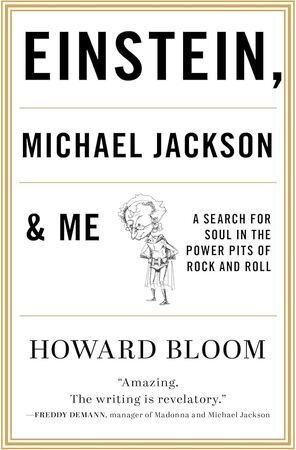
With the world gearing up for the highly anticipated Michael biopic, the global conversation around Michael Jackson is reigniting at full force—and there has never been a better moment to rediscover one of the most intimate, intelligent, and revealing books ever written about him.
Howard Bloom—a man who stood at the crossroads of science, music, and cultural evolution—offers something no outsider ever could: proximity, perspective, and profound understanding. In Einstein, Michael Jackson & Me, Bloom doesn’t just recount encounters—he decodes them.
This is not a typical celebrity memoir. It is a rare fusion of science and soul, where Bloom connects the genius of Albert Einstein with the revolutionary artistry of Michael Jackson. Through his firsthand experiences working at the highest levels of the music industry, Bloom reveals Jackson not just as a performer, but as a force of evolutionary change—someone who reshaped global emotion, identity, and connection.
As audiences prepare to witness Michael Jackson’s story on the big screen, Bloom’s book offers something deeper: the truth behind the myth, the intellect behind the magic, and the humanity behind the legend.
At a time when the world is once again asking who Michael Jackson really was, Einstein, Michael Jackson & Me provides an answer that is as bold, brilliant, and unforgettable as the man himself.
This is an excerpt from a French magazine article written about Howard Bloom and his experiences and perspectives involving Michael Jackson.
Below is an excerpt that was written in the French magazine “Rage” regarding Michael Jackson and the relationship he had with Jackson
Howard Bloom reflects on the day of Michael Jackson’s death—June 25, 2009—saying he always felt there were unfinished conversations between them. It took him years to understand why.
He recalls initially refusing opportunities to work with the Jackson family in the early 1980s. To him, they were “too easy”—so famous that any journalist could secure access. Bloom prided himself on pursuing more difficult, meaningful “crusades,” not easy wins.
Eventually, after repeated outreach, he agreed to meet them. He describes himself as socially unconventional growing up, more comfortable with animals than people, and unfamiliar with typical human rituals. Still, he believed in facing people directly and honestly—if you say no, you say it to their face.
Later, Bloom reflects on the changing nature of rebellion in music. He describes how artists like John Mellencamp and bands such as Spandau Ballet and Berlin expressed themselves differently—sometimes through physical gestures like a raised fist. But over time, rebellion in popular music softened into acceptance.
He notes that Michael Jackson stood apart: rather than traditional rock rebellion, Jackson expressed intensity and power through unique gestures—like his signature pointed finger—marking a shift in how artists communicated identity and emotion on stage.
Bloom also touches on the broader cultural backdrop, noting that during the relatively prosperous Reagan era, rebellion evolved. In more stable times, younger generations could afford to challenge norms—but by the 2000s and 2010s, that rebellious energy had changed, becoming less central to mainstream music.
The official website for Howard Bloom may be found at https://www.howardbloom.net
Article by Bruce Kent