
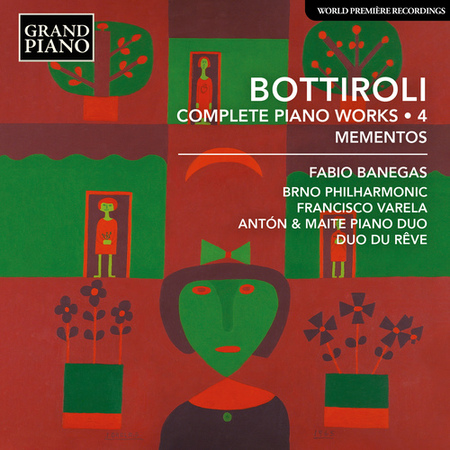
Fabio Banegas continues his personal mission of championing his mentor’s work in the modern era with his latest release, “Bottiroli: Complete Piano Works, Vol. 4”. This album is the final volume of Banegas’ survey of José Antonio Bottiroli’s piano-centered output, and mixes solo piano, duo, chamber, and piano-and-orchestra works.
Bottiroli was a composer who seemed to live between post-Romantic warmth, Impressionist shading, and flashes of Argentine folk color. Banegas pays homage to this legacy by letting the music speak for itself through an intimate and melodically generous repertoire. The result is an album that succeeds through sincerity rather than trying
to inflate Bottiroli beyond his deserved accolades.
Album BUY/STREAM link: https://grandpiano.lnk.to/GP959AC
Artist micro-site: https://grandpiano.lnk.to/FabioBanegasPianistAC
The album impresses from its opening with “Symphonic Impressions on Some Themes by Mario Tarenghi, B8”. This is a bright piece that stands out for its lyricism, with string, flute, and brass melodies accompanying the piano.
Banegas showcases his virtuosic solo work later on in the record with his “Toccata in E Minor, B52”. in the context of a program otherwise rich in reflective character pieces, this sparkling miniature lands as a shot of nervous energy. If there is a risk, it is that such a brief piece can pass before it leaves a fully distinctive profile.
“Adagio in C Minor, B77 ‘Adagio ritornel’” is one of the emotional anchors of the disc. One of the longer solo items, it gives Banegas room to show his tonal control and patience. This is where Bottiroli’s post-Romantic side registers most strongly: sustained line, melancholy shading, and a refusal to hurry the emotional point.
The album closes with “Suite for 2 Pianos in B Flat Major, B24 ‘Argentina’”. This piece highlights Bottiroli’s use of Argentine folk dances such as the chamamé, and is a work where national character comes to the front.
The production on this album is exceptional for a classical record, with perfectly balanced orchestras and great melodic focus on the piano solos. There’s never a moment where the sound feels overly engineered, and the acoustic beauty of the arrangement is preserved immaculately.
This album is a persuasive and enjoyable record that rewards regular listens. It doesn’t feel groundbreaking, and relies on strengths such as melodic grace, stylistic range, and Banegas’ clear devotion to the repertoire. For listeners interested in neglected 20th-century piano literature, this is a deeply worthwhile release.