
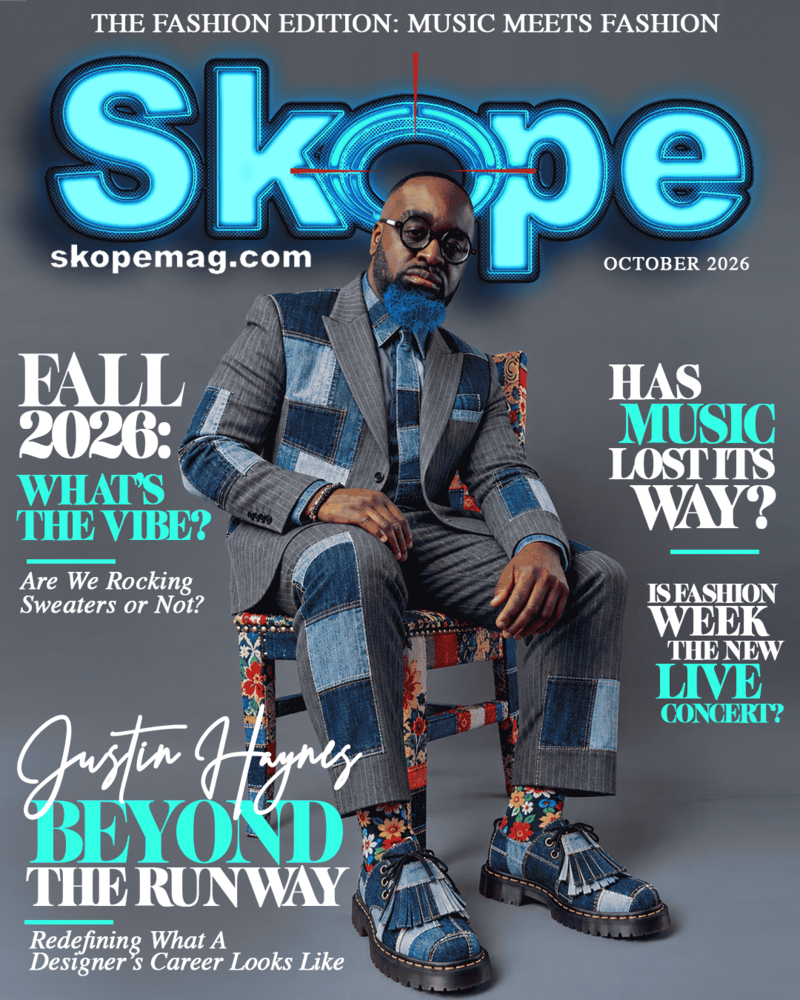
On any given week, Justin Haynes might be in a fitting room adjusting the drape of a sleeve, sitting in a council meeting discussing the future of an international fashion market, or in a studio shaping the sound that will accompany his next collection down the runway. None of these rooms look like each other. None of them, on their own, look like “designer.” And that’s precisely the point.
The word has always implied a fairly narrow arc: build a label, release collections on a seasonal calendar, chase visibility until a runway show becomes a moment. It’s a model built for a specific kind of career, one measured in drops, in press cycles, in how loudly a name travels each fashion week. Justin Haynes has quietly stepped outside that frame altogether, and in doing so, he’s offering a preview of what a fashion career can look like when it isn’t confined to a single lane.
A Career Built in Parallel, Not in Sequence
Most designers build a career in a straight line, collection to collection, show to show. Haynes has built his in parallel tracks that inform each other rather than compete for attention.
As Vice Chairman of the Independent Tokyo Fashion Council and Vice President of the West Africa Fashion Council, his work is less about styling and more about shaping infrastructure, deciding how fashion ecosystems grow, who gets access, and how creative capital moves between regions. This isn’t advisory work in the traditional sense of sitting in on decisions; it’s strategic, often invisible, and rarely photographed.
His advisory role at the 2026 Golden Globes operated on a different register entirely. There, the work was less about fabric and more about fluency, an understanding of how clothing communicates on a stage where every choice is read as a statement about identity, power, and cultural nuance.
And then there’s sound. Haynes’ Fashion Soundtrack project, developed with producer Smokey Lavell, isn’t a side hustle or a marketing flourish. It’s become a genuine extension of how he designs, proof that his creative practice was never going to stay confined to garments in the first place.
Taken individually, these could each read as accolades. Taken together, they sketch the outline of a different kind of career altogether, one shaped less like a portfolio and more like a body of ongoing work across disciplines.
A Signal, Not an Outlier
This shift isn’t happening in isolation. Across fashion, the role of “designer” has started to stretch. Creative leaders are increasingly being pulled into rooms that have nothing to do with fabric, advising cultural institutions, sitting on councils, shaping conversations at the intersection of fashion, music, and media. The industry is quietly redefining what expertise at this level is expected to look like.
Haynes’ path is an early, clear example of where that shift leads. He isn’t diversifying for the sake of relevance. Each area he’s stepped into, council leadership, cultural advising, sound, reflects the same underlying instinct: that fashion is a language, and a designer fluent in that language has something to say well beyond a twelve minute runway show.
What Comes Next
If the traditional designer career is a straight line toward a bigger show, Haynes’ path suggests something closer to a widening field of view: new rooms, new collaborators, new formats for saying the same thing he’s always said, that clothing is never just clothing.
Where that leads next isn’t fully written yet. But if the last few years are any indication, it won’t look like what came before it, for him, or for the industry watching.
Follow Justin Haynes
Instagram: @theofficialjus10h
Facebook Page: Justin Haynes – JUS10H