
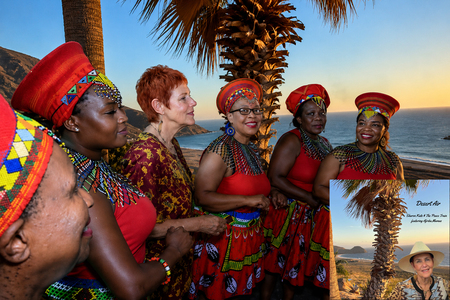
Sharon Katz has spent much of her career making borders feel musically irrelevant. Her latest release, “Desert Air” continues that tradition, featuring South African rhythms alongside jazz, folk, rock and international influences. Recorded across Durban, Todos Santos and San Diego, the six-track release brings together South African musicians with collaborators from the United States and Mexico, giving the music a genuinely cross-continental character.
Katz’s guitar is joined by Qhubekani Mthethwa’s bass, Charles Boykie Mnomiya’s drums, Debbie Mari’s keyboards, George Mari’s flugelhorn and David Church’s saxophone, but the instrumentation is designed to complement rather than overwhelm. The songs favor warmth, groove and human interaction over sonic spectacle.
It is available on all favorite streaming services: https://sharonkatzthepeacetrain.hearnow.com/desert-air
“Oh Baby Baby” provides the project’s most immediate burst of energy. Its rolling rhythm and call-and-response interplay between Katz and Afrika Mamas give the song the communal quality that has always suited The Peace Train particularly well. Thematically, it’s a simple reminder to not to leave affection unspoken, and that simplicity works because the performance supplies the character.
“Someone to Love” moves into smoother territory as David Church’s saxophone and Debbie Mari’s keyboards push the song toward mellow Afro-jazz. Mnomiya’s drumming keeps the arrangement gently moving beneath Katz’s vocal, creating a sense of softness with plenty happening underneath.
The title track, “Desert Air,” provides the EP’s thematic center. Featuring Wendy Quick alongside Katz, it turns its attention toward the natural world and the need to preserve what the Earth provides. “Turn the Page” provides a fitting finish as it discusses leaving old patterns behind. Mthethwa’s bass provides the foundation while Katz brings in distorted guitar and George Mari adds flugelhorn, resulting in one of the EP’s more unusual instrumental combinations.
After a record built largely on breezy warmth, the rougher guitar textures toward the end send a simple message. Change requires the willingness to step outside familiar structures. If there is a weakness, it comes from the same quality that makes Desert Air so inviting. Its gentleness occasionally risks becoming too comfortable.
Desert Air isn’t trying to reinvent Sharon Katz & The Peace Train. It distils what the group already does particularly well: South African rhythmic foundations, warm ensemble playing, and socially conscious songwriting. Katz has built a record that’s deliberately human-scaled and played by musicians who recognize that conversation matters.