
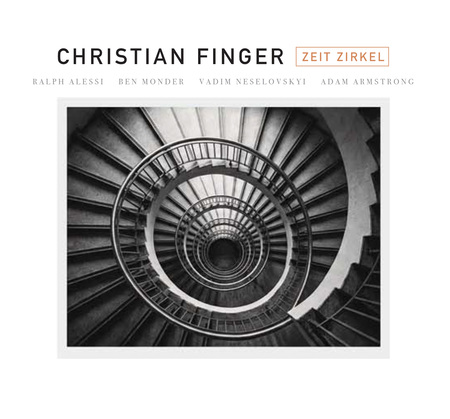
Drummer and composer Christian Finger turns inward on his latest release, “Zeit Zirkel.” Where much of his earlier work has drawn on the meeting points between jazz, classical music, world music and cinematic composition, this forthcoming album is built around something more intimate: the strange way time changes shape in the presence of grief.
Scheduled for release on October 1, 2026 through Finger Music, the 13-track album brings Finger together with trumpeter Ralph Alessi, guitarist Ben Monder, pianist Vadim Neselovskyi and double bassist Adam Armstronn; an unusually well-matched ensemble for music concerned with emotional ambiguity.
https://www.christianfinger.com/
https://www.instagram.com/fingerchristian/?hl=en
Rather than treating grief through uniformly somber ballads, Finger allows the music to move through contrasting emotional states. Opener “Alta Anima” establishes that approach through a reflective piano theme, balanced Monder’s countermelody and an increasingly fiery trumpet presence.
“Hope and Hope” almost immediately complicates the mood, beginning with an energetic trumpet-bass-drums configuration before widening with guitar and eventually settling into a more hymn-like conclusion. “Fifteen PM” is one of the album’s major peaks, where blazing trumpet, forceful drumming and Monder’s rock-edged guitar are balanced by a particularly inventive piano statement from Neselovskyi.
The most personal moment on his record may be “Gentle Garden.” The piece places Armstrong’s bass prominently within the music, but the accompanying album artwork adds another important detail: Finger dedicates the composition to Herta Finger. In the context of an album explicitly addressing death and loss, the dedication gives the surrounding concept a human center. It makes Zeit Zirkel a meditation on mortality and more like music produced
Ultimately, Zeit Zirkel seems strongest when viewed not simply as an album “about grief,” but as one about what happens afterward. Its emotional world contains despair, yet also agitation, beauty, humor, motion and moments of genuine release. The record’s thirteen compositions repeatedly shift perspective, suggesting that loss never disappears so much as becomes incorporated into the continuing movement of life.