
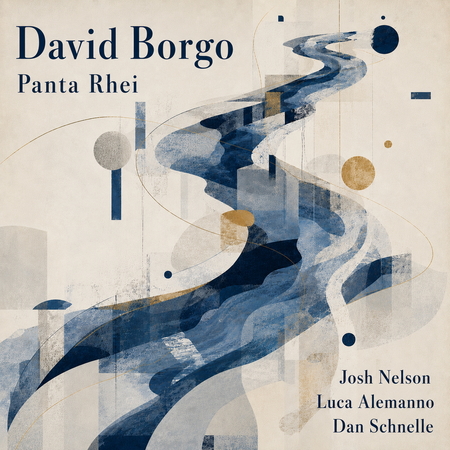
Jazz saxophonist David Borgo has long approached improvisation as something more substantial than spontaneous embellishment. For him, it is a means of exploring uncertainty and the behavior of complex systems, and “Panta Rhei” brings that intellectual foundation directly into the foreground. Its title translates into “everything flows” in
Greek, and that concept is presented through written material that provides a recognizable channel, renewed through listening and collective response each time the musicians enter it.
The album is performed by a finely balanced acoustic quartet: Borgo on tenor and soprano saxophones, Josh Nelson on piano, Luca Alemanno on double bass and Dan Schnelle on drums. The familiar instrumentation gives Borgo room to pursue sophisticated ideas without burying them beneath an oversized arrangement.
https://sites.google.com/ucsd.edu/davidborgo
https://davidborgo.bandcamp.com
The opening track, “Blissando,” takes inspiration from the Shepard–Risset glissando, an auditory illusion in which pitch appears to rise or fall endlessly. Borgo answers that illusion with ascending and descending piano harmonies moving against one another, culminating in a saxophone line that folds back over itself while the drums intensify.
The title composition is equally meticulous. “Panta Rhei” features contrapuntal arrangements where the saxophone, keys, and bass deliver competing melodies. These pieces are not simply vehicles for conventional solos; they are systems designed to produce motion, friction and unexpected routes through the material.
Such structural ambition can easily become clinical, but the album actually contains a delightful warmth to it. Substantial pieces such as “Flow” and “Málaga” are offset by the brief “Paro” and “Longing.” These pieces act as moments of compression and reflection between the longer ensemble journeys.
At nearly every point, the titles reinforce the central concern with movement, interruption, departure and impermanence. The closing piece, “Longing,” is almost poetic in that regard. It’s a short number characterized by gentle instrumentation that leaves you wanting more as it quietly bows out.
Panta Rhei is an intelligent and unusually coherent modern-jazz statement, and its greatest achievement may be the way its philosophy mirrors jazz itself. The tune remains identifiable, but the relationships, gestures and emotional meaning are never reproduced in exactly the same form.