
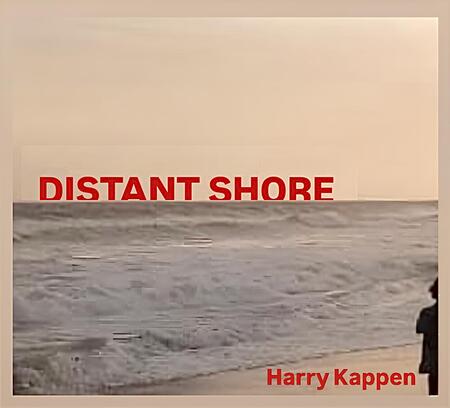
There’s a moment in Harry Kappen’s “Distant Shore” where the whole song seems to levitate right out of the room and hover somewhere over black water at 3 a.m., somewhere between a prayer and a panic attack, somewhere between Bowie’s lost astronauts and the exhausted souls packed into rubber boats trying to outrun death with nothing but desperation and bad weather. And man, that’s where rock and roll still matters. Right there. In that ugly, human trembling.
Because “Distant Shore” is not one of these fake empathy songs where some millionaire singer puts on sadness like a designer jacket for four minutes and then goes back to the minibar. No, this thing feels lived-in. Haunted. Harry Kappen may have voluntarily moved from the Netherlands to Mexico, but instead of turning the experience into some self-help memoir soundtrack about “finding himself,” he looked outward. He looked at the people who don’t get to choose. Refugees. Families torn out by war, poverty, terror, collapsing governments, collapsing humanity. People who leave because staying means dying slower.
And somehow he turned that into a rock song that sounds simultaneously intimate and cosmic.
The mellotron is the first thing that gets you. It doesn’t enter the song so much as drift through it like fog carrying old radio transmissions from another planet. Kappen openly tips his hat to David Bowie’s “Space Oddity,” and you can hear it immediately — not as imitation, but as spiritual inheritance. Bowie used space travel as alienation; Kappen uses the ocean. Same abyss. Same terror. Same question: will anybody hear me if I disappear?
https://www.youtube.com/watch?v=wtYdESzrp8w
“I kiss the door I can’t replace…”
That line hits like somebody trying to memorize the smell of their own home before it vanishes forever. And then the song starts moving — trucks crowded with “forty souls,” engines screaming, prayers muttered in panic. The arrangement never explodes into melodrama. That’s the genius of it. Kappen restrains the whole thing just enough to let the dread seep in naturally. He understands something most modern producers forgot sometime around the invention of Spotify-core mood music: atmosphere is emotional violence.
And the chorus? Jesus. It doesn’t soar; it reaches. Big difference.
“Where is that distant shore…”
Not where is salvation. Not where is freedom. Just where is the shore? Anywhere solid. Anywhere human. The simplicity kills you.
What’s remarkable is how personal the performance feels considering Kappen played and produced the entire thing himself. The multi-instrumentalist angle usually leads to bloated vanity projects where artists mistake control for vision. But here, the isolation works in the song’s favor. Everything sounds slightly enclosed, slightly trapped, as if the instruments themselves are trying to escape confinement. The drums pulse instead of pound. The keyboards drift like lights in fog. Even the guitar solo sounds less like heroics and more like somebody screaming through static.
And underneath it all sits Kappen’s voice — weary, compassionate, unpretentious. He doesn’t oversing because he knows the subject matter already carries enough weight. That restraint gives “Distant Shore” its gravity. The song never begs you to care. It simply tells you what fear sounds like.
Which is why this thing sticks.
Because in 2026 we’re drowning in disposable content masquerading as music. Algorithmic wallpaper. Plastic outrage. Fake vulnerability packaged by branding consultants. Then along comes a track like “Distant Shore,” and suddenly you remember that songs can still function as moral documents. They can still bear witness.
Kappen has always operated outside the mainstream machinery, collecting awards and acclaim while building his own strange, thoughtful body of work. But “Distant Shore” feels bigger than career momentum. It feels necessary. A song about migration, survival, and fragile hope arriving at a moment when the world keeps trying to turn suffering into statistics.
Lester Bangs used to believe great rock and roll should risk embarrassment by caring too much. “Distant Shore” does exactly that. It cares recklessly. Openly. Without irony.
And in an age terrified of sincerity, that might be the most rebellious sound of all.
–Leslie Banks