
By Robert Mitchell
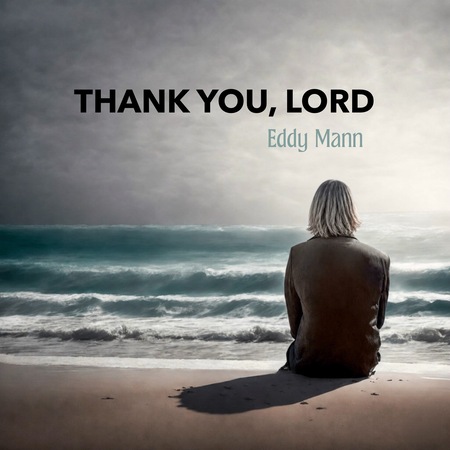
There’s an old truth about popular music that the record business keeps trying to bury: the best songs aren’t necessarily the loudest, the slickest, or the ones with the biggest promotional budgets. Sometimes they’re the ones that tell us something about being alive that we already knew but had somehow forgotten. Eddy Mann’s “Thank You Lord,” arriving November 6, 2026, belongs to that tradition. It’s a modest song with an unusually substantial emotional foundation, and its greatest strength is its refusal to confuse simplicity with insignificance.
Mann, the Philadelphia/Melbourne FL-based Christian singer-songwriter whose career has produced chart-topping singles and numerous industry honors, isn’t breaking new musical ground here. That’s not the point. He’s working within one of the oldest traditions in American music: turning personal testimony into something a community can recognize as its own.
The source material makes that achievement particularly meaningful.
In the summer of 2009, Mann’s mother was keeping a journal filled with prayers, reflections, and expressions of gratitude. She died four years later, leaving those handwritten observations behind. When Mann began revisiting her journals, he discovered that her particular way of addressing God contained its own musical possibilities.
The phrases suggested melodies. The language established rhythms. What began as a private conversation between a woman and her Creator became the foundation for a public expression of faith.
That’s a remarkable transformation, but it also connects “Thank You Lord” to a long American musical history.
https://www.youtube.com/watch?v=fXFPxAFd-SU
Gospel music has always understood that personal experience becomes powerful when it’s shared. From the earliest spirituals to the great gospel recordings of Mahalia Jackson and the Staple Singers, the essential question wasn’t whether a song demonstrated technical sophistication. It was whether the singer believed what was being sung, and whether that belief could reach somebody else.
Mann’s songwriting operates on a quieter scale, but the principle remains the same.
The lyrics are almost startlingly direct. The singer gives thanks for the blessings, wonders, grace, favor, and mercy of an ordinary day, returning repeatedly to a prayer for God’s loving care. There’s no elaborate narrative, no dramatic theological argument, and no attempt to manufacture an emotional crisis where none exists.
Instead, the song depends on repetition and accumulation.
That approach has obvious risks. Contemporary Christian music too often treats repetition as a substitute for musical development, stretching a simple sentiment beyond its natural capacity. But Mann’s conception is different. These aren’t phrases designed primarily to generate an arena-sized singalong. They’re words drawn from a genuine devotional practice, where returning to the same thought becomes a method of contemplation.
The distinction matters.
Mann has described the recording as a moment captured during the song’s ongoing evolution, rather than a composition locked into some final, supposedly perfect arrangement. That openness reflects an understanding of worship as something lived rather than merely performed.
It also points toward a larger problem in contemporary religious music. Too much of the genre has absorbed the commercial assumptions of mainstream pop without questioning whether those assumptions serve its spiritual purpose. Songs are increasingly designed to deliver predictable emotional payoffs, with carefully calculated dynamics and familiar lyrical formulas.
“Thank You Lord” offers another possibility: a song whose importance comes from the life behind it rather than the machinery surrounding it.
The biblical inspiration, Psalm 118:24, reinforces that perspective. The passage celebrates the day itself as an occasion for rejoicing. Mann’s mother’s journals give that familiar message a human dimension. Gratitude isn’t presented as an abstract religious obligation. It’s something practiced in the middle of ordinary existence.
And that may be the song’s most valuable contribution.
The recording also raises questions about memory and inheritance. We tend to think of musical legacies in terms of famous performers, influential recordings, and historic achievements. But families preserve their own musical traditions, sometimes without recognizing them as such. A parent’s words, a remembered prayer, or a familiar turn of phrase can become a form of cultural inheritance every bit as meaningful as a celebrated songbook.
By transforming his mother’s private writings into music, Mann makes that inheritance audible to others.
As the first single from his forthcoming Dreaming with God album, scheduled for September 2027, “Thank You Lord” establishes an artistic direction grounded in humility and reflection.
It won’t satisfy listeners demanding revolutionary musical innovation or confrontational social commentary. Nor should it have to. Its ambition is different: to preserve an authentic voice, communicate an enduring belief, and make a simple expression of gratitude meaningful beyond the circumstances of its creation.
That’s not a small achievement.
Popular music has always been at its most essential when it helps ordinary people recognize their own experiences in somebody else’s story. Eddy Mann has taken his mother’s words and given them another life.
The result reminds us that some of the most important things music can communicate aren’t complicated at all.
Sometimes they’re only two words.
Thank you.