
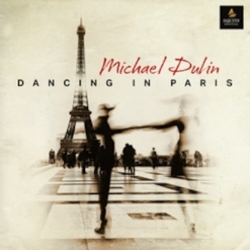
Some instrumental songs are less like compositions and more like places you have somehow visited before. Michael Dulin’s “Dancing In Paris” belongs to that idea. Even without lyrics, the track creates a vivid romantic setting, turning an unrealized journey into something surprisingly tangible. The story behind the piece is part of its appeal. Dulin had been planning a romantic trip to Paris, but the trip ultimately became a visit to Italy at his wife’s request. Instead of simply letting the Parisian fantasy disappear, he transformed the idea into music. The result is an instrumental love letter to a city he never reached, proving that inspiration does not always require an experience to have actually happened.
FACEBOOK: https://www.facebook.com/MichaelDulinMusic
The imaginative quality is hardly surprising considering Dulin’s background. A pianist, composer and virtuoso, he has built a reputation around emotional depth and masterful musicianship. His style occupies an interesting space between contemporary instrumental music and classical tradition, with jazz providing much of its rhythmic and harmonic freedom. His compositions are known for lush harmonies, intricate phrasing and expressive dynamics, and those characteristics are particularly evident here.
“Dancing In Paris” introduces itself with pure style and conviction. The distinctive beat drives the whole thing underneath piano and saxophone soloing, establishing the track’s sophisticated but approachable character. The piano takes a front eat, where Dulin gets his first major opportunity to command the arrangement. The playing is technically impressive without becoming an exercise in showing off. Instead, the virtuosity serves the atmosphere. Horns subsequently expand the sound, giving the arrangement greater dimension before another piano solo brings Dulin back to the foreground. The production allows each instrument room to breathe, making the track remarkably clear and balanced.
Nothing sounds buried simply to make another instrument appear more important. What really makes the song especially effective is its ability to occupy several musical worlds at once. There is unmistakably a vintage jazz sensibility, but the production and melodic accessibility give it a modern edge. It is sophisticated enough for attentive listening yet inviting enough to work on the radio, during a long drive, or as the soundtrack to a quiet evening. Dulin’s musical history gives this sense of assuredness some context. His extraordinary ability emerged early: as a child prodigy, he could reproduce music by ear after hearing his older sister practice. At twelve, he performed Schumann’s Concerto with the Alabama Symphony Orchestra before continuing his education at Juilliard under renowned pianist and teacher Adele Marcus.
https://open.spotify.com/album/3KoZ4UeVpWzLxW6MZEPwJ1
“Dancing In Paris” works because it sounds and feels human. In an era increasingly dominated by manufactured sounds, Dulin’s performance celebrates patience, personality, and a lot of genuine musicianship. This is polished jazz, certainly, and it never feels stale. It swings, breathes and communicates. Paris may have remained a destination on paper, but through Dulin’s piano, the journey becomes real.
Gwen Waggoner