
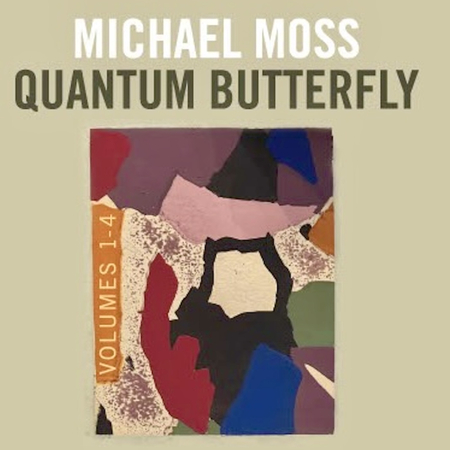
Michael Moss has spent decades treating jazz less as a fixed language than as a point of departure. On Quantum Butterfly, Moss expands his scope to a 4-volume anthology that runs more than four hours and brings together Moss’s ROOTS to SHOOTS ensemble, standards associated with some of modern jazz’s most important figures, and a substantial excursion into electroacoustic music.
What makes Quantum Butterfly compelling is that it doesn’t attempt to smooth those different strands into a single aesthetic. Instead, Moss allows them to coexist. His roots in hard bop, free jazz, modern classical composition and music from outside the American jazz tradition all remain audible as distinct forces.
The first volume, “ROOTS to SHOOTS,” establishes the collection’s most immediately accessible side. Chick Corea’s “La Fiesta” begins from an exuberant samba pulse, while Duke Ellington’s “Come Sunday” brings another easygoing connection to jazz history. But even here Moss refuses to remain comfortably inside straight-ahead jazz. “Amitabha” pushes soprano saxophone against odd meters, percussion and increasingly free improvisation.
Volume 2, “Ensemble Bows for Strings, Piano and Reeds,” makes the collection considerably more abstract. The 19-minute “Abyss” places Moss among strings and piano in music whose reference points extend toward Stravinsky, Shostakovich and the Third Stream. The conceptual heart arrives on Volume 3, “Quantum Butterfly”. “Samson’s
Walk” begins in a comparatively traditional setting, with Moss’s tenor stealing the spotlight. Meanwhile, “Freedom Chant” brings Afro-Cuban rhythmic energy and increasingly liberated interplay.
The fourth disc brings Moss back toward the jazz lineage with another “ROOTS to SHOOTS” performance, recorded at Westbeth in September 2025. Here the repertoire includes Bill Evans’ “TTTT” alongside Moss’s “March On,” leaning heavily into the themes of improving upon past perfomances.
If Quantum Butterfly has a potential obstacle, it is that there is a great deal of music here. Moving from swinging post-bop to electronic composition and everything in between within four hours demands more attention than the average jazz release. But that scale ultimately works because Moss himself supplies the through-line. Whether surrounded by strings, electronics, vibraphone or a hard-swinging rhythm section, his music remains driven by curiosity rather than stylistic loyalty.