
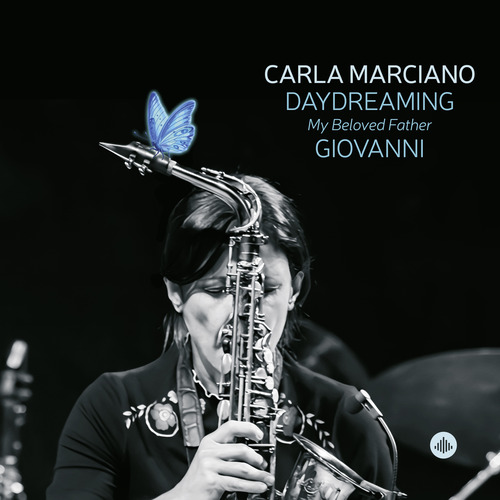
Born from grief and centered around inheritance, Carla Marciano’s “DAYDREAMING My Beloved Father GIOVANNI” is a compelling record that goes beyond simple feelings of loss. This is really an album about inheritance: the emotional habits, values, dreams and, above all, love of music that remain after somebody is gone.
Marciano created the record as a tribute to her late father Giovanni, the man she describes not only as a parent but as her first and “true music teacher.” As a child, she remembers him singing and playing guitar while she began playing recorder, experiences she credits with igniting her lifelong passion for music.
Marciano gives herself a suitably broad canvas on this album as it contains eight original compositions, with their own distinct styles. Marciano appears on alto and sopranino saxophones alongside her long-established collaborators Alessandro La Corte on keyboards, Aldo Vigorito on double bass and Gaetano Fasano on drums.
Marciano’s alto and sopranino act as the expressive center of music as the album opens with “Daydreaming;” a piece that starts out as dreamily as the name implies and intensifies as it progresses. The record moves into more ballad-like material with “Giovanni (Your Sweet Smile),” a tribute single that’s every bit as warm and mellow as its name implies.
Marciano shows her versatility with the improvisational spaces in works like “Flying” and the more expansive “Hypnagogic State,” which runs for nearly 12 minutes. A hypnagogic state exists between sleeping and waking, which fits beautifully with Marciano’s entire idea of “daydreaming”: the album repeatedly occupies that uncertain emotional territory in which somebody is physically absent yet remains vividly present in memory.
There is another small but meaningful touch in “We Stay at Home,” which incorporates a saxophone introduction based on Charles Trenet and Léo Chauliac’s “Que reste-t-il de nos amours?”, essentially, “What remains of our loves?” In the context of this album, that question could almost serve as its subtitle. Marciano’s answer is music.
Daydreaming feels less like music written for the dead and lands like music addressed to someone who remains present. Its subject is absence, certainly, but its language is gratitude. Marciano herself states she could not follow Giovanni into his profession as a doctor, but she did inherit his artistic spirit. DAYDREAMING My Beloved Father GIOVANNI turns that inheritance into perhaps the most personal statement of her career.