
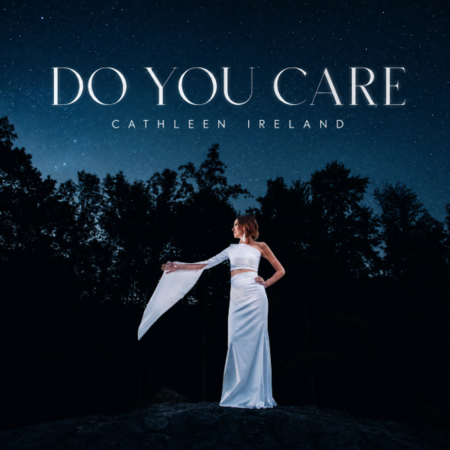
By Doug Marshall
Popular music has always reflected the technologies people use to fall in love and break each other’s hearts. Telephones gave songwriters busy signals and unanswered calls. Cars supplied backseats, highways and departures. Cathleen Ireland’s “Do You Care” belongs to the era of blocking, ghosting and deleted connections—a time when another human being can seemingly remove you from existence with one tap.
Ireland understands that the technology may be new, but the emotional damage is not. “Bae, bae, block me / But you can’t stop me,” she sings, drawing a line between restricting communication and extinguishing feeling. Her former companion can close an account, erase a photograph or refuse a message, but none of those gestures can rewrite the relationship inside her memory.
That distinction gives “Do You Care” more substance than its playful pop language initially suggests. Phrases such as “ka-ka-catch me” and “ga-ga-ghost me” create rhythmic hooks, but they also convey emotional disruption. Ireland sounds caught between trying to communicate and recognizing that no one is listening.
https://youtu.be/7QAyNBQ8l9s?si=Fo8Nc-T8qb1-lVYz
The song’s most affecting passages are its least defensive. “I just wanna talk to you / Wanna be unblocked to you / I just wanna be your friend again,” Ireland admits. There is no fantasy of immediate empowerment here, no claim that losing the relationship has made her stronger by the second chorus. She wants something basic: acknowledgment from a person who once mattered.
That desire leads to the central question, “Do you care enough for me?” Ireland repeats it because unanswered questions repeat themselves. Anyone who has been abruptly cut off understands the cycle: disbelief becomes self-examination, self-examination becomes bargaining, and bargaining returns to disbelief. The chorus captures that circular thinking without requiring an elaborate metaphor.
“Wasn’t I good to you?” she asks later. “I’m not perfection, babe / But I was true to you.” It is an important qualification. Ireland does not declare herself blameless. Instead, she argues that imperfection should not invalidate loyalty or erase shared history. In a culture increasingly comfortable with treating people as removable content, that argument carries weight beyond one failed romance.
The polished pop-R&B production keeps the single moving even when its narrator remains emotionally stranded. Its accessible hooks make the message immediate, while Ireland’s performance supplies the adult perspective necessary to keep the digital terminology from becoming a gimmick. She sings as someone who knows the difference between losing access to a person and losing the need for that person.
“Do You Care” offers no easy resolution because the situation does not have one. The absent party never answers. Ireland is left with memory, uncertainty and a question that technology cannot solve.
That is the song’s real point. We have invented faster ways to disappear from one another, but we have not invented a faster way to stop caring. Cathleen Ireland gives that contradiction a strong melody, an honest voice and a chorus built to linger long after the screen goes dark.