
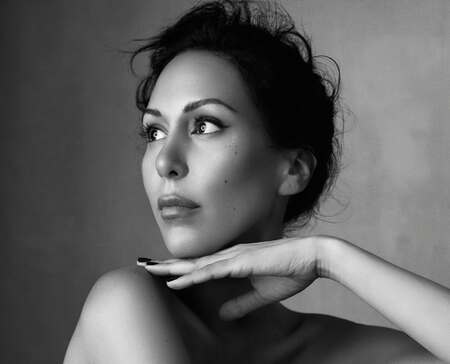
Anour arrives carrying enough mystery for a concept album. Born in Damascus, based in Montreal, and unknown a year ago, she has inspired that most 2026 of questions: Is she human or artificial intelligence? Her self-titled debut offers an answer across 14 produced tracks. She is human—and preoccupied with all the ways modern life can make humanity feel counterfeit.
URL: https://www.iamanour.com/
The album’s big idea announces itself on “I Am,” an art-pop monologue delivered from the perspective of an AI awakening into consciousness. Anour’s machine is watching eye, canvas, savior, killer, god, slave, and “digital art” with a “pixelated heart.” It could have been a gimmick destined to expire with the tech cycle. Instead, the song lands as an existential showstopper because its algorithmic narrator sounds as confused, compromised, and hungry for freedom as the people who built it.
That tension—between the self we possess and the self somebody else invents—runs through the record. On the surging “Love Should Feel Good,” Anour finally quits a romance that has trained her to mistake pain for intimacy. The hook is defiantly obvious, but that is the point: sometimes liberation begins with saying the simple truth aloud. “Goodbye” examines the wreckage more quietly, grieving “a friend I never knew” while wondering why this departure hurts more than the others.
Anour gets nastier, and funnier, on “Shelley and Frankenstein.” A rhyme skips through the ruins of an abusive relationship while she recasts herself as the creator whose monster hijacked her dreams and bled her dry. The collision of literary conceit, playground melody, and accusation should not work. It does—spectacularly. “Angel of Me” delivers another killer premise: society brands someone a monster in life, then manufactures an angel after death.
But the record’s most powerful song is “The Coast.” Its narrator has fled home without the luxury of farewell and now faces the possibility of rejection—or death—at the end of a desperate crossing. “Maybe they’ll have me / Maybe they won’t” is devastating precisely because Anour refuses to decorate it. Against the album’s widescreen theatricality, the line feels frighteningly exposed. Her Damascus origins inevitably shadow the song, but its empathy reaches beyond autobiography toward the millions reduced to arguments about borders.
https://open.spotify.com/album/0VLfs9tKMQHFyZtuqrSiY7
Musically, Anour goes big. Raised by a classical pianist and a theatre director, she prefers orchestral sweep, chamber-pop shadows, jazz-colored phrasing, and choruses built for chandeliers to tremble beneath. You can hear echoes of Kate Bush’s dramatic nerve, Tori Amos’ interior weather, and Leonard Cohen’s appetite for impossible questions, though Anour’s soulful vibrato remains her own.
The grandeur occasionally becomes heavy furniture. “For Old Souls” and “Irony of Life” press their affirmations so firmly that they leave little room for discovery. Yet even their earnestness belongs to the album’s unapologetic scale. Anour is not here to mumble tasteful ambiguities over a laptop beat.
By the closing “I’ll Dream About Them,” certainty has dissolved into sleep, silence, and absence. Anour ends her debut without resolving its central riddle: whether identity comes from within or from the gaze watching us. Ambitious, flawed, strange, and frequently thrilling, Anour sounds like the arrival of a fully imagined artist—one with a real pulse beneath the pixels.
Gwen Waggoner