
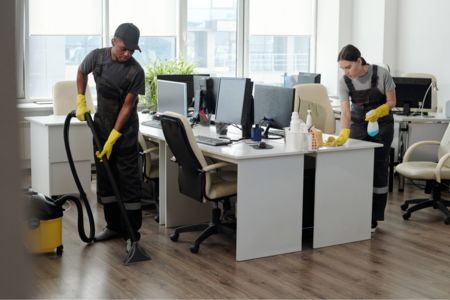
Image Source: Yandex.com
Research that people form impressions of trustworthiness and competence in as little as 100 milliseconds. That is faster than conscious thought. And once formed, these impressions are incredibly difficult to reverse due to confirmation bias, the psychological tendency to seek evidence that supports initial judgments rather than contradicts them.
For businesses, this means clients decide whether you are competent before anyone greets them, before they review your credentials, and before they understand your pricing. They decide based on what they see, smell, and feel when they enter your space. The physical environment is not a backdrop. It is the opening argument for your professionalism.
According to the British Cleaning Council, 84% of people are likely to form a negative opinion of a business if the environment is unclean or untidy. Visitors notice details that employees overlook because they see the space with fresh eyes. Dust in corners, scuff marks on walls, stains on carpets, and odors in restrooms stand out immediately. These subconscious judgments happen within seconds and can permanently affect how your business is perceived.
For commercial cleaning companies in San Antonio, where medical practices, law firms, financial advisors, and corporate offices compete for the same professional clientele, maintaining a clean and well-presented facility can be a key competitive advantage.
The Psychology of Clean Spaces
Neuroscience research indicates that emotion plays a central role in decision-making, especially when people operate with incomplete information. Clients choose the firm that feels right, then justify the decision with logic. A clean, organized office creates positive emotional associations that spill over into broader judgments about competence, trustworthiness, and quality. Psychologists call this the halo effect.
The reverse is equally powerful. A slow response or generic experience signals risk. When a client encounters dusty surfaces, stained carpets, or unkempt restrooms, they subconsciously associate those conditions with broader operational standards. A law firm with smudged glass does not look detail-oriented. A medical office with debris in corners does not look sanitary. A financial advisor with scuffed floors does not look successful.
The International Sanitary Supply Association found that 94% of people would avoid a business in the future if they encountered dirty restrooms. This statistic illustrates how a single negative environmental cue can override positive experiences in other areas. The condition of your office is not separate from your service. It is part of the service that clients evaluate.
Health, Productivity, and Retention
The benefits of regular office cleaning extend beyond visitor perception to the people who work there every day. The Centers for Disease Control and Prevention estimates that workplace illnesses cost U.S. employers over $225 billion per year in productivity losses. Germs spread rapidly on shared surfaces. Research from the University of Arizona found that a single contaminated door handle can spread viruses to 50% of office surfaces within hours.
Regular disinfection by professional janitorial teams limits this spread. When employees stay healthy, absenteeism drops, and so do the indirect costs associated with temporary coverage, project delays, and decreased morale. The CDC’s guidance on cleaning and disinfecting facilities recommends routine cleaning and disinfection of facilities and frequently touched surfaces.
Dust exposure creates subtler but equally significant problems. The ISSA, the worldwide cleaning industry association, reports that dust exposure affects workers’ cognitive skills by 2 to 6%, impacting typing, arithmetic, logical reasoning, memory, and creative thinking. Unplanned absences cause a 54% decrease in productivity and output, along with a 36% drop in sales and customer service performance.
Research found that workers in clean offices are up to 12% more productive than those in poorly maintained spaces. Dust accumulation, odors, and clutter reduce concentration, while visible cleanliness contributes to satisfaction and motivation. A company investing in professional cleaning might see a 5% productivity lift across staff, generating gains that far exceed the service cost.
Asset Preservation and Long-Term Value
Routine janitorial maintenance extends the lifespan of facility assets by 20 to 40%, lowering capital expenditure over time. Dirt and debris act as abrasives, breaking down carpet fibers, tile finishes, and painted surfaces. HVAC systems clogged with dust require more frequent servicing. Neglected restrooms and breakrooms can lead to plumbing or pest problems that demand expensive remediation.
For property owners and facility managers, this preservation represents hidden ROI. Protecting physical assets that represent significant sunk costs is not glamorous, but it is financially sound. Professional cleaning pays for itself through deferred replacement and reduced emergency maintenance.
What Regular Office Cleaning Actually Includes
Understanding the scope of professional office cleaning helps businesses evaluate what they are getting and why it matters. A comprehensive service goes far beyond surface tidying.
Daily maintenance includes trash removal, restroom sanitization, dusting of horizontal surfaces, vacuuming of carpeted areas, and break room cleaning. These tasks preserve basic order and prevent the accumulation of visible debris.
Deep cleaning addresses what daily maintenance cannot reach. This includes high-touch disinfection of door handles, elevator buttons, light switches, and shared equipment. It covers detailed kitchen and breakroom cleaning, baseboard and vent dusting, and the extraction of embedded soil from carpets and upholstery.
Floor care is particularly consequential for first impressions. Hard surface stripping and waxing restores protective coatings and shine. Tile and grout cleaning eliminates discoloration and microbial growth. Carpet cleaning removes deep soiling that dulls appearance and harbors allergens.
Specialized services may include window cleaning, air duct cleaning, and post-construction cleanup. Each contributes to the overall impression of the space and the health of its occupants.
The San Antonio Business Environment
San Antonio’s commercial landscape has characteristics that influence cleaning needs. The climate generates dust and pollen that enter buildings through ventilation and foot traffic. Extended warm seasons mean air conditioning runs continuously for months, circulating any contaminants present in the ductwork. The city’s growth has brought new construction and renovation, introducing drywall dust, adhesive residue, and debris that can linger long after contractors leave.
Stone Oak and other master-planned business corridors feature medical offices, corporate suites, and retail spaces where presentation standards are high and competition is intense. In these environments, facility condition is part of the service being sold. Clean offices do not guarantee success, but they remove a barrier that can undermine otherwise excellent work.
Choosing the Right Cleaning Partner
When selecting the right provider, businesses should evaluate expertise, reliability, and accountability rather than focusing solely on price.
Experience with commercial environments matters. Residential cleaning and office cleaning require different equipment, scheduling flexibility, and attention to detail. Providers who understand the specific needs of medical facilities, law firms, or corporate headquarters can tailor their approach.
Training and consistency are essential. Background-checked, uniformed technicians who receive ongoing education deliver better outcomes than rotating subcontractors who lack facility familiarity.
Equipment quality directly affects results. Commercial-grade auto-scrubbers, HEPA-filtered vacuums, and pH-balanced cleaning solutions achieve what consumer-grade tools cannot.
Transparent communication builds trust. Clear proposals, documented service schedules, and responsive issue resolution demonstrate professionalism that matches the standards the cleaning service is meant to maintain.
Conclusion
Regular office cleaning is an investment in the impression your business makes before anyone speaks. It affects how clients perceive your competence, how employees experience their workplace, and how your brand is remembered after the visit ends. The data is clear: cleaner spaces correlate with higher satisfaction, better health outcomes, stronger professional relationships, and measurable productivity gains.
For San Antonio businesses seeking to maintain these standards, working with a Commercial Cleaning Company San Antonio that understands local conditions, commercial requirements, and the importance of consistent quality is a practical decision with documented returns. The cost of professional cleaning is modest compared to the potential loss of clients, talent, and credibility that neglected facilities risk.
San Antonio Carpet Cleaning provides commercial office cleaning services throughout San Antonio and surrounding areas including Stone Oak, Alamo Heights, and Helotes. Their trained technicians handle daily maintenance, deep cleaning, floor care, and specialized services with scheduling designed to minimize business disruption.