
By Marcus Ellison
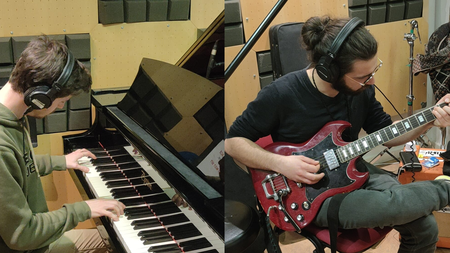
There are records that are built, records that are polished and records that simply happen. Clouds, the four-track instrumental EP from guitarist Altin Gjoni and French pianist Julien Gaiffe, belongs defiantly to that last category. It is the sound of two musicians entering a room, abandoning the map and trusting the invisible current passing between them.
Recorded live at Brentford Studios in West London, Clouds grew out of the musical friendship Gjoni and Gaiffe formed while studying together in London. That history matters because this is not guitar music with decorative piano, nor is it a piano recital wearing an acoustic-guitar scarf. This is a genuine conversation. Both musicians listen as intently as they play, and the silence surrounding their notes often carries as much emotional weight as the notes themselves.

The opening title track establishes that relationship immediately. “Clouds” is an appropriate name for both the composition and the EP because this music refuses to remain in one emotional shape. Melancholy drifts into reassurance. Stillness gathers into tension. Gjoni’s guitar lines suggest the instincts of a player who has spent years learning when a song needs another note and when it needs room to breathe. Gaiffe, meanwhile, does not merely supply harmony. His piano changes the emotional temperature of the performance, introducing colors that allow Gjoni’s phrases to mean something different each time they return.
“Birds” carries that sense of movement into the EP’s most quietly liberating passage. Its nearly four-minute flight demonstrates the duo’s shared understanding of improvisation: freedom is not the absence of discipline but the reward for mastering it. Gaiffe’s touch can feel weightless one moment and searching the next, while Gjoni alternates between melodic fragments and textural gestures. Neither musician chases spectacle. They chase feeling, which is infinitely harder to fake.
The third track, “Travels,” expands the record’s emotional geography. Gjoni’s guitar provides motion without imposing a fixed destination, while Gaiffe’s piano adds shifting shades of light and weather. One instrument proposes; the other responds. Their roles change naturally, sometimes within the space of a few measures. The piece feels less like a conventional composition than a collection of memories passing outside a train window—clear for a moment, then gone before they can be completely understood.
Then comes “Almost Midnight,” the track that best captures the partnership’s strange after-hours magic. It has the atmosphere of an empty London street after the noise has died down and every passing thought suddenly seems significant. Gaiffe brings nocturnal elegance to the piece, his piano carrying both intimacy and uncertainty. Gjoni answers with guitar lines that sound less performed than confessed. Together, they create the sensation of standing at the threshold between one day and the next, when the past is still close enough to touch but the future has already begun whispering.
That sense of transition also reflects Gjoni’s larger artistic story. As detailed in an AirGigs interview, the Albanian-born guitarist built his career as a session musician, adapting to different artists, genres and production demands. He has spent years serving other people’s songs—the noble, frequently invisible work of the musician behind the musician. His playing has been shaped by classic and progressive rock, along with the expressive economy of session greats such as Tom Bukovac and Dan Huff.
With Clouds, Gjoni begins stepping out from behind that curtain. This is his first complete instrumental EP, but it does not sound like a session player making a noisy grab for center stage. The instinct to serve the music remains embedded in every performance. The difference is that the emotional world being served is now partly his own.
Gaiffe is essential to that transformation. His piano is not a backdrop for Gjoni’s emergence as a solo artist; it is the catalyst that made the emergence possible. Meeting the right musical partner at the right moment gave Gjoni a new language in which to express himself. In return, Gjoni gives Gaiffe an open landscape where the pianist’s lyricism, restraint and spontaneous invention can fully register. Clouds works because neither man attempts to dominate it.
The performances were held back for nearly a year before the pair selected four live takes for release. That distance may have helped them recognize what they had captured: not perfection in the antiseptic modern sense, but presence. These recordings retain the breath, risk and human vulnerability that editing can easily erase.
At just over 13 minutes, Clouds is brief, but it feels complete. There are no vocals, grand solos or production fireworks demanding attention. Instead, Gjoni and Gaiffe invite the listener into the room where two classmates became musical partners and intuition became composition.
The EP can be heard on Spotify, while more of Gjoni’s original music and session work is available through The Working Guitarist. Clouds captures a door opening for both musicians. More importantly, it makes you want to hear where they go after walking through it.