
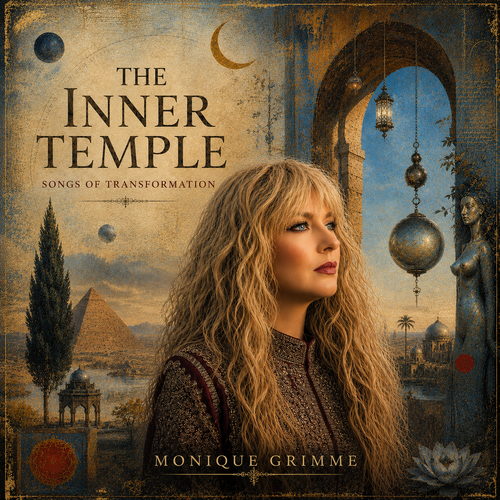
There is a point at which music transcends acoustics and ascends into a more mystical space. On her latest album, “The Inner Temple (Songs of Transformation),” Monique Grimme sets out deliberately to reach that point. Across ten tracks concerned with positivity, compassion, wisdom, and personal awakening, she constructs a musical pilgrimage whose destination is not somewhere beyond the listener, but somewhere within.
Released through Bongo Boy Records on August 13, The Inner Temple represents a particularly spiritual turn in Grimme’s increasingly adventurous catalogue. The album announces that intention immediately with “Magic of Positivity (Sonic Ritual).” Featuring Wickliffe Mott, the track establishes atmospheric worldbeat textures, chanting, spacious production and Grimme’s lead vocal operating as a guide through the song.
SONG TITLES for the studio album:
THE INNER TEMPLE
(songs of transformation)
1. Magic of Positivity (Sonic Ritual) ft. Wickliffe Mott 3:58
2. Measured by Moments 4:12
3. Wisdom & Fools 3:33
4. Trust Your Kindness 4:30
5. Naturally Reality 3:37
6. Cut By A Rose 3:39
7. Change Your Thoughts 3:14
8. Rise From Within (Introspection) 3:37
9. Compassion ft. Wickliffe Mott 4:18
10. Love and Harmony 4:33
From there, singles like “Wisdom & Fools” and “Trust Your Kindness” make Grimme’s intentions refreshingly clear. She is not interested in disguising the record’s philosophy beneath ambiguity. These are songs about evaluating what matters, resisting cynicism and choosing a more constructive way of moving through the world.
While her work is undeniably innovative, Grimme has been moving toward this territory throughout her recent work. Her use of global, cinematic and rhythm-driven arrangements stands out on “Cut By A Rose,” which was previously released as a single. It uses the beauty and pain of the rose as a metaphor for relationships in which attraction and hurt become inseparable.
That tension gives added meaning to the latter stretch. “Rise From Within (Introspection)” turns the journey decisively inward before the record closes with “Love and Harmony.” The album’s trajectory becomes apparent through its thematic development. Positivity is something reached through reflection, self-awareness and an intentional change of perspective rather than a simple denial of difficulty.
The Inner Temple is music imagined as architecture; a sequence of rooms devoted to deep reflection and finally harmony. You do not necessarily have to subscribe to every piece of its spiritual vocabulary to appreciate the care with which Grimme has built that space. And perhaps that is the album’s most persuasive idea. Transformation does not arrive as one gigantic revelation. It occurs through moments, thoughts, wounds, decisions and repeated acts of compassion.