
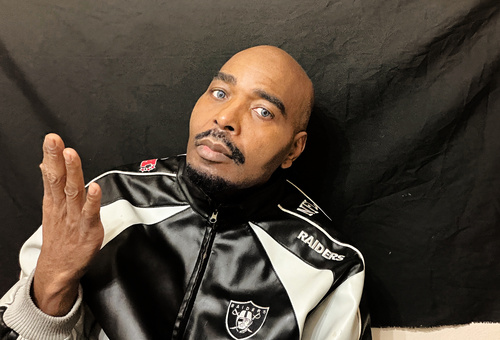
For Billy Ray Rock, looking backward has become an unexpected way of figuring out how to move forward.
His latest single, “This the Town I’m From,” returns to the Fresno streets of his childhood, revisiting the people, experiences and seemingly insignificant moments that helped form his identity. But what might initially sound like a hometown tribute carries considerably more weight. Following the death of his wife, Rock now hears those memories differently. The song has become a bridge between who he was, what he has lost and the future he is still learning how to embrace.
“Having just lost my wife of a number of years, I felt like it was the time to kind of reflect,” Rock says. “If I am to try to move forward and try to find some form of happiness in my future, I guess it starts with rebooting my foundation in some strange way.”
That foundation is Fresno, a place Rock affectionately describes as the “biggest small town” he has encountered. Positioned between San Francisco and Los Angeles, Fresno exists outside the gravitational pull of either metropolis, developing what Rock sees as an insulated personality of its own.
“It’s a town where people are pretty cliquish,” he explains, “so it has a real, almost shell around it.”
Inside that shell are the memories that populate “This the Town I’m From.” Rock remembers walking barefoot to the store, playing games with neighborhood children and spending time with family. There is nothing spectacular about these recollections, and that is precisely what makes them valuable.
As children, ordinary experiences rarely announce themselves as future treasures. Only decades later do they become landmarks.
“I think they become powerful because they are simple things that you’re never likely to repeat as an adult,” Rock says.
Growing up poor also permanently altered his understanding of abundance. Things others might regard as routine can still feel luxurious to him. At the same time, the resourcefulness required during childhood helped shape both his character and his work ethic.
That ability to create something from whatever was available eventually extended to music.
Rock grew up absorbing artists who might now be separated into entirely different playlists: Hall & Oates, Elton John, the Ohio Players and Earth, Wind & Fire among them. Instead of teaching him to identify musical boundaries, that eclectic education taught him to ignore them.
“When you’re creating, nothing is off the table,” he says. “If it feels good, then let it happen. Don’t lose sleep worrying about genres; lose sleep worrying if it sounds good.”
It is an uncomplicated philosophy that explains Rock’s willingness to move among styles rather than allowing radio formats to dictate his identity. Fatherhood has pushed him even further away from chasing trends.
Becoming a parent, Rock says, made him more conscious of the subjects he explores and encouraged him to examine what was happening internally rather than focusing on whatever happened to be popular at radio.
That shift toward substance over recognition has accelerated with age and loss.
Rock admits there was once a certain satisfaction in the “shine” that accompanied creating a successful song. Today, applause is increasingly irrelevant compared with the possibility that his music might genuinely affect someone.
“The shine that you receive from a song creation is temporary,” he says. “The feeling that people feel from the music you make is more long lasting and contributes more to your legacy as an artist.”
Few songs demonstrate that evolution more clearly than “This the Town I’m From.”
Before his wife’s death, the song’s backward glance primarily reminded Rock of his parents and siblings he had lost. Now his wife occupies that emotional landscape as well. Because she had such a powerful connection to the song and its video, the recording has become what Rock describes as a kind of monument to yesterday.
It has also changed how he approaches today.
Raising their two children without her has made him increasingly conscious of the fragility of time. He tries to appreciate every interaction more deeply, even while acknowledging that grief has made him more anxious about his children’s emotional and physical well-being.
That tension gives the song an importance far beyond hometown pride. Fresno provides the geography, but loss supplies much of its contemporary meaning.
“This the Town I’m From” is ultimately concerned with the strange way the past continues accompanying us. Childhood poverty can become adult gratitude. Neighborhood games can become lessons in creativity. The music heard on the radio decades ago can become permission to ignore genre boundaries. A song written about parents and siblings can suddenly become inseparable from the memory of a spouse.
Rock understands now that legacy isn’t necessarily the attention an artist receives while making music. It is what remains inside someone else after the song ends.
That is also what he hopes Skope Magazine readers take from “This the Town I’m From.” He isn’t asking listeners to adopt his memories or see Fresno exactly as he sees it. Instead, he wants the song to prompt their own inventory.
“I hope that they think about where they come from,” Rock says, “and what it is they can take from that past to help them make a better future.”
For Billy Ray Rock, that process is already underway.
He is returning to Fresno, to childhood, to family and even to grief—not because he wants to live in yesterday, but because somewhere inside yesterday are the pieces he needs to build tomorrow.