
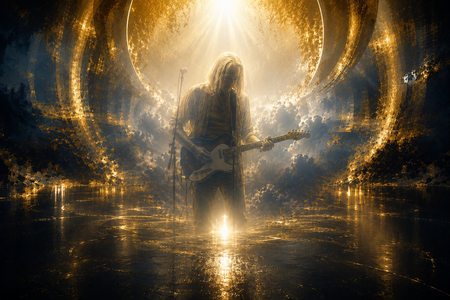
By Jack Brennan
There’s something almost beautifully perverse about Eddy Mann writing a worship song in 5/4.
Think about it. Contemporary worship music has spent decades perfecting the art of predictability. Four beats. Four chords. Build. Drop. Whisper. Explode. Repeat the chorus until somebody raises both hands. The machinery works, which is precisely why so much of it feels like machinery.
Then Mann wanders in with “We Are,” a strange little jazz-inflected prayer inspired by Revelation, and apparently nobody bothered to tell the song that worship music is supposed to behave itself.
The funniest part is that Mann claims he didn’t deliberately write it in 5/4. The song simply landed there.
Good.
Music ought to occasionally know something its creator doesn’t.
“We Are,” from Mann’s The Unveiling, grew out of Revelation 4, specifically that cosmic scene around the throne where creation itself seems overwhelmed by the sheer existence of God. Mann takes that gigantic image and does exactly the opposite of what you’d expect: he gets quiet.
There are no theological fireworks here. No seven-headed beasts wandering through the second verse. No musical attempt to reproduce the apocalypse with synthesizers and a choir of 400.
Instead, Mann boils everything down to a handful of declarations.
“Holy.”
“Worthy.”
“We are Your will.”
That’s basically the whole spiritual universe of the song.
And somehow it’s enough.
The key is that crooked 5/4 pulse. It gives “We Are” a peculiar sensation of constantly moving without ever marching. You can’t quite settle into the usual worship-song autopilot because there’s always that extra beat nudging the music sideways. The rhythm breathes strangely. It leans forward, catches itself, then keeps going.
Which, come to think of it, isn’t a bad metaphor for faith.
Mann’s jazz influence matters here because jazz understands uncertainty. Jazz understands that resolution means more when you’ve spent some time wandering around outside it. Traditional contemporary worship often wants to tell you exactly where you’re going and precisely when you’re going to arrive. “We Are” seems more comfortable allowing the listener to inhabit the moment.
That’s where Mann has increasingly distinguished himself.
He isn’t trying to be the youngest guy in Christian music, the loudest guy in Christian music, or the coolest guy in Christian music. He’s writing from the perspective of somebody who has lived long enough to understand that faith isn’t necessarily demonstrated by shouting louder.
Sometimes it’s demonstrated by staying.
And The Unveiling is fundamentally an album about staying.
The record takes its inspiration from Revelation, possibly the most spectacularly abused book in the entire Bible. For generations, people have turned Revelation into everything from theological mathematics to political prophecy to material for terrifying church-basement movies. Mann looks at the same text and keeps finding hope.
That’s almost rebellious.
“We Are” goes even further by stripping away much of the fear surrounding Revelation and returning to something elemental: worship. Before arguments about beasts and seals and trumpets and timelines, there is awe.
Mann seems fascinated by that awe.
His repeated “We are Your will / We are Your desire / We are Your pleasure” becomes increasingly interesting the longer you sit with it. The words aren’t about asking God for anything. That’s unusual enough in a culture where prayer can sometimes resemble a celestial Amazon wish list.
There’s no new job here.
No miracle requested.
No enemy requiring immediate smiting.
No promise of earthly prosperity.
Mann simply considers existence itself an act of divine intention.
That’s heavy stuff disguised as a modest jazz-worship song.
And modesty may actually be Mann’s greatest weapon. He doesn’t sing like he’s auditioning for God. There’s no desperate vocal gymnastics designed to prove sincerity. His approach has the weathered character of someone who understands that conviction doesn’t require theatrical reinforcement.
The music follows him there.
Instead of exploding toward some enormous climax, “We Are” remains contemplative. Jazz harmony gives the spiritual language room to breathe, and that unusual meter prevents the whole thing from becoming comfortable background music.
You have to listen.
Maybe that’s the point.
Because beneath all the biblical inspiration, sophisticated rhythmic structure, and sacred-jazz vocabulary, “We Are” is really about one of humanity’s oldest questions:
Why are we here?
Mann’s answer is almost ridiculously simple.
Because we are wanted.
In another singer’s hands, that idea could become syrupy enough to pour over pancakes. Mann avoids that trap because The Unveiling has already established the landscape surrounding these songs: struggle, uncertainty, mortality, perseverance and the stubborn possibility of redemption.
Hope isn’t particularly interesting when nothing hurts.
Mann knows that.
So “We Are” doesn’t sound like somebody discovering faith for the first time. It sounds like somebody who has dragged faith through a few decades of living and discovered that it still has a pulse.
A weird pulse, admittedly.
Five beats at a time.
And maybe that’s exactly right. Because if you’re going to write a song about an eternal God, cosmic creation, human purpose and the mysterious machinery of existence, why the heck should everything resolve neatly on four?
–Leslie Banks