
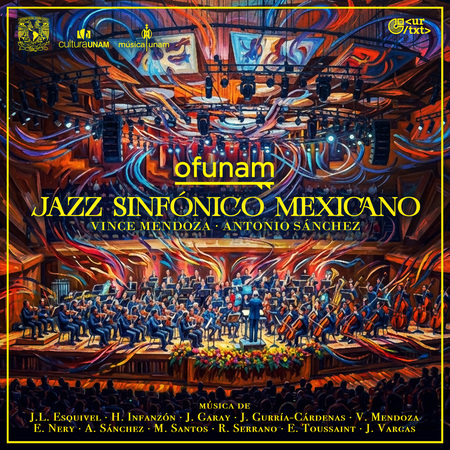
Orquesta Filarmónica de la UNAM: Vince Mendoza: Guest conductor, Antonio Sánchez: Special guest soloist, drums , Tim Mayer: Alto sax, soprano sax, Juan Manuel Navarro: Alto sax, Diego Franco: Tenor sax ,Ernesto Ramos: Tenor sax, Abel Sánchez: Baritone sax, soprano sax, clarinet , Flavio Meneses: Guitar ,Fernando De Santiago Vihuela, Alex Mercado: Piano, Aarón Cruz: Bass, Mario García: Drums
“Jazz Sinfónico Mexicano” is more than an orchestral jazz showcase. The Orquesta Filarmónica de la UNAM delivers a carefully curated argument for Mexican jazz as a broad, multigenerational tradition. Guest conductor Vince Mendoza guides the orchestra through a program featuring vernacular rhythms, contemporary concert music, cinematic orchestration and open-ended improvisation that is still undeniably Mexican.
The album’s greatest strength is its refusal to treat “symphonic jazz” as merely jazz melodies decorated with strings. Instead, the orchestra, saxophones and rhythm section operate as distinct musical forces. Mendoza’s role is critical here, as he fuses guest performers into the orchestra, acting as an architect keeping several musical languages in conversation.
Vince Mendoza’s “Partido Alto” makes an ideal opener, as it brings Mendoza’s experience with large jazz ensembles directly into OFUNAM’s world. Its Brazilian rhythmic foundation immediately avoids concert-hall formality, announcing that rhythm will remain the album’s central source of movement.
This is followed by José Luis Esquivel’s “Noir”, a piece inspired by the film language of the 1940s and 1950s. It introduces a darker and more atmospheric personality to the album, demonstrating that Mexican jazz goes beyond a single definition. Jhoely Garay’s “Monarcas” expands that cinematic quality into something organic, drawing inspiration from Mexican ecosystems to develop its ethereal tone.
https://musica.unam.mx/calendario/evento/61633/
https://music.youtube.com/playlist?list=OLAK5uy_m14X8XSpQ1-vzjP7TP0nGe0uiG23Arcp8
The center of the program feels warmer and more closely tied to Mexican vernacular traditions. Serrano’s “Guapanguito”, previously presented in a Latin Grammy-nominated big-band arrangement, appears here in symphonic form. Enrique Nery’s “Agave” follows later in the program, building on the concept of combining jazz with Mexican traditional idioms.
The program builds convincingly toward its two closing works. José Gurría-Cárdenas’s “Amalayón” changes the dramatic scale of the album as the drum kit becomes a central protagonist confronting, supporting and redirecting the orchestra. Antonio Sánchez’s “Minotauro” is the natural climax, bringing together the project’s three most important creative forces. Mendoza supplies large-ensemble experience, Serrano translates that vision for OFUNAM, and Sánchez provides the rhythmic identity and improvisational danger.
Jazz Sinfónico Mexicano succeeds because it treats Mexican jazz as a living network rather than a fixed style. Its older compositions are not presented as museum pieces, and its ambition, historical significance and compositional range outweigh any reservations. It documents an unusual institutional commitment to Mexican jazz while also producing a substantial musical experience in its own right.