
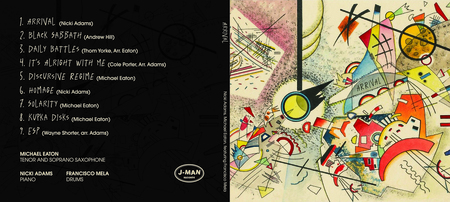
On their latest album, “Arrival,” pianist Nicki Adams and saxophonist Michael Eaton turn an apparent absence into the album’s defining strength. There is no bassist in this trio; only Adams on piano, Eaton on tenor and soprano saxophones, and featured artist Francisco Mela on drums. but the music never feels incomplete, and instead, the missing instrument opens space for a more fluid relationship between rhythm, melody and texture.
The opening title track demonstrates the transformation immediately. Built around a propulsive 12/8 Afro-Cuban pulse, “Arrival” introduces Eaton’s searching tenor against Adams’ agile rhythmic architecture. Adams frequently supplies intricate bass figures with his left hand, but this is not simply a conventional trio with the piano covering an absent role. Mela enters with forceful, dramatic interventions, and the performance never settles into a simple groove.
That balance between structure and instability runs throughout the record. The trio can swing hard, but its swing rarely feels decorative or nostalgic. On Andrew Hill’s “Black Sabbath,” the musicians embrace the composition’s angularity while turning it into one of the album’s most energetic performances.
https://michaeleatonmusic.com/
Adams’ “Homage,” meanwhile, brings freely inspired stride piano into the group’s modern vocabulary. It is a telling combination: a historical pianistic language placed inside music that remains open and unmistakably contemporary. “Solarity” offers another side of the trio, adopting a more open backbeat while retaining the album’s appetite for rhythmic displacement.
The closing arrangement of Wayne Shorter’s “ESP” completes the album’s central argument that complex composition does not necessarily restrict improvisation, but creates more provocative conditions for it. Adams’ version reportedly includes a reference to Olivier Messiaen’s Quartet for the End of Time, linking the jazz standard to the classical influences that have long informed his partnership with Eaton.
Mela is crucial to making all of this feel alive. He brings fire, color and unpredictability, responding to complicated meters and forms with an unusually direct sense of movement. At times, his freer approach seems to pull the compositions apart; elsewhere, his command of swing reconnects the music to the tradition beneath its more experimental surfaces.
The album’s greatest strength is also its main challenge. Arrival contains dense counterpoint, irregular meters, and references ranging from M-Base to Messiaen. Adventurous without completely rejecting accessibility, Arrival presents three musicians treating jazz tradition not as a boundary but as a flexible source of momentum. The bassist may be absent, but the music carries considerable weight.