
There is an old American story that keeps rewriting itself. It begins with the promise that reinvention is always possible—that no matter how badly we’ve failed, we can pack up, head west, start over, and become someone new. It is the mythology of the frontier, the revival tent, the open highway, and the second chance.
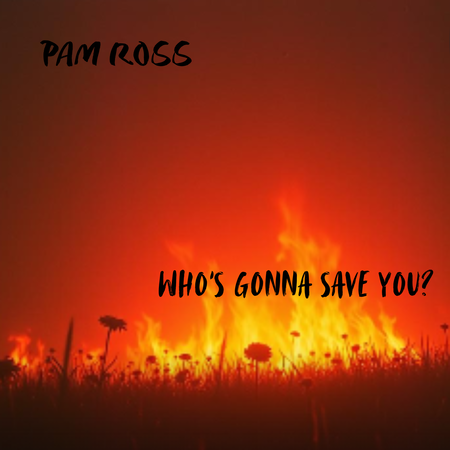
Pam Ross’s “Who’s Gonna Save You?” quietly asks what happens when that story stops working.
The song is built on familiar terrain: roots-rock guitars, a steady rhythm section, and Ross’s unassuming vocal delivery. Nothing announces itself as revolutionary. Yet beneath that musical familiarity lies something far more unsettling. Ross isn’t interested in the enemies outside the gates. She is documenting the collapse that begins from within.
“If you can’t have it, burn it down.”
That line echoes through the song like a confession disguised as determination. It speaks not only to one person’s despair but to a broader impulse that has always haunted American life—the temptation to destroy what cannot be perfected. The desire to erase failure by reducing everything to ashes has appeared in politics, religion, relationships, and art. Ross condenses that impulse into a handful of devastating verses.
Then comes the chorus, and with it, the song’s central question:
“God might save you from someone else, but who’s gonna save you from yourself?”
The brilliance of the lyric is that it refuses certainty. It acknowledges faith without using it as an easy resolution. God is present, but human responsibility remains unavoidable. The question hangs unanswered because perhaps it cannot be answered by anyone but the listener.
Ross sings with remarkable restraint. There is no theatrical anguish, no exaggerated display of pain. Instead, she sounds like someone who has reached the point where emotion no longer needs to announce itself. That calm gives the performance its authority. The words land harder because they are delivered without spectacle.
The musicians surrounding her understand the assignment. Yvan Petit’s guitar never overwhelms the lyric but colors it with subtle tension. FJ Ventre’s bass and George Hindenach’s drums create a foundation that keeps the song grounded, while Ross’s keyboards and organ add a quiet sense of inevitability, as though the music has been moving toward this destination long before the first verse begins.
The production resists the temptation to smooth away the rough edges. Instead, it allows silence, space, and texture to become part of the narrative. Every instrument serves the story rather than competing with it.
What ultimately distinguishes “Who’s Gonna Save You?” is its refusal to become either sermon or therapy session. It offers neither condemnation nor consolation. Instead, it documents a moment familiar to anyone who has stood amid the wreckage of their own decisions and wondered whether redemption begins with rescue—or with recognition.
In that sense, Pam Ross has written more than a song about doubt. She has written a song about the uneasy bargain at the heart of self-determination itself. We celebrate the freedom to make our own lives, yet we seldom acknowledge the equal freedom to dismantle them.
“Who’s Gonna Save You?” doesn’t answer its own question.
It simply leaves the echo ringing long enough for us to discover whether we’re asking it of the song—or of ourselves.
–Marcus Grey