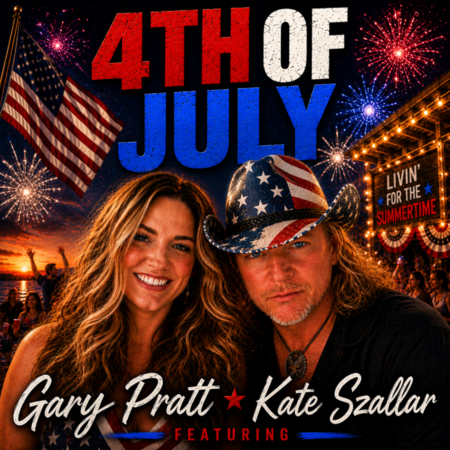
There’s a peculiar kind of magic in a country song that knows exactly what it wants to be. It doesn’t apologize for wearing its heart on its sleeve. It doesn’t chase irony. It doesn’t wink at the audience as if sincerity were somehow embarrassing. Gary Pratt’s “4th of July” throws open the front door, cranks the stereo, and says, “Come on in.” You either accept the invitation or you miss the party.
The funny thing is, the title points you in one direction while the song heads somewhere entirely different. You think you’re about to hear another seasonal anthem stuffed with red, white, and blue clichés. Instead, Pratt steals the imagery of Independence Day and repurposes it for something infinitely more personal. Fireworks aren’t exploding over a city park—they’re going off between two people who’ve discovered that chemistry can outshine any holiday spectacle.
That’s the kind of songwriting twist that makes you grin.
Country music has always been strongest when it shrinks enormous emotions into ordinary rooms. This song never leaves the house. It doesn’t need to. A couch becomes the center of the universe. A kiss becomes the opening act. Suddenly February feels hotter than July, and the whole calendar loses its meaning because love has invented its own season.
It’s a deceptively simple concept, but simplicity has always been underrated. We spend so much time praising complexity that we forget how difficult it is to write something immediately understandable without becoming predictable. Pratt threads that needle beautifully.
His vocal performance carries the easy confidence of someone who trusts the song enough not to oversell it. He doesn’t force emotion into every syllable or chase vocal gymnastics for their own sake. Instead, he lets the melody do the heavy lifting. The result feels conversational, almost effortless, and that’s precisely why it works.
Then Kate Szallar steps into the picture.
Her presence changes the song from a statement into a relationship. She’s not there for decoration or marketing value. She adds dimension, creating little moments where the performance feels less like a recording session and more like overhearing two people who genuinely enjoy making each other smile. That kind of chemistry can’t be manufactured with studio tricks.
The production deserves its own standing ovation. Adam Ernst—whose credits include Bailey Zimmerman, Mickey Guyton, and Chase Matthew—handles every instrument himself, and somehow the record never feels like a one-man exercise in virtuosity. Instead, it feels cohesive, almost handcrafted. Every guitar phrase arrives exactly when it should. The rhythm section pushes without crowding the vocal. Nothing exists merely because it can.
That’s increasingly rare.
Modern country often mistakes excess for excitement. Bigger drums. Bigger guitars. Bigger everything. “4th of July” remembers that excitement comes from momentum, not volume. The groove keeps moving, the chorus keeps climbing, and before long you’re humming along whether you intended to or not.
The real triumph here is emotional honesty. Pratt isn’t trying to reinvent romance. He’s reminding us why we keep writing songs about it in the first place. Because every generation thinks they’ve discovered fireworks for the first time. Every couple believes their story is unlike any other. Music exists to preserve those illusions, and thank goodness it does.
By the closing refrain, with the repeated declaration that it “keeps getting better than the Fourth of July,” the song has quietly accomplished something bigger than delivering another catchy chorus. It’s argued that love isn’t measured by grand gestures or national holidays. Sometimes it’s measured by choosing to stay inside, turning off the world, and discovering that the brightest celebration is the one nobody else gets to see.
Gary Pratt has delivered a summer single that will undoubtedly soundtrack backyard parties and holiday weekends. But after the grills cool off and the fireworks smoke drifts away, “4th of July” has enough heart to keep playing long after the calendar flips to August.
The best celebrations aren’t always the loudest. Sometimes they’re just the ones you never want to end.
–Leslie Banks