
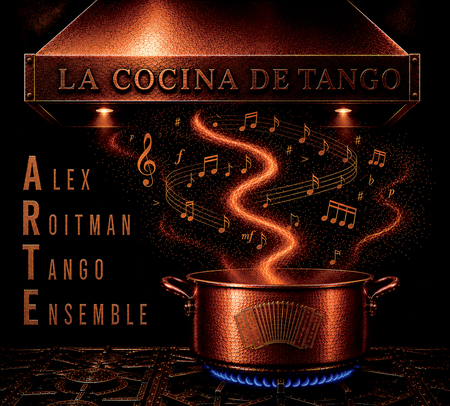
Sarasota-based bandoneonist Alex Roitman and his ensemble offer a compact but richly flavored debut album with “La Cocina de Tango.” With a runtime of thirty-three minutes, the album respects Argentine traditions while refusing to simply perform known standards.
The album brings together newly arranged traditional works, pieces by Astor Piazzolla, a contemporary composition by Finnish composer Sami Pirttilahti, and four Roitman originals, all performed by Roitman on bandoneon, Nayiri Piloyan on violin, Mayu Funaba on piano, and Carlos Maldonado Cisneros on double bass.
The classic side of the program is immediately attractive. “Aníbal Troilo” gives the set a bright, energetic opening, while Piazzolla’s “Chau, París” pushes the ensemble into more modern, harmonically restless territory. Roitman’s bandoneon naturally becomes the emotional center of the sound, but the album’s arrangement concept seems designed to keep the violin, piano, and bass in constant dialogue.
https://www.youtube.com/@arte-tango
What gives the record its identity is the balance between dance-floor clarity and concert-hall detail. Roitman shares that “La Cocina de Tango” pays tribute to Tango Kitchen, a building associated with the Stowe Tango Music Festival, where the music was rehearsed, refined, and partly shaped by the festival community. But this is not tango presented as museum music; it is animated, alert, and conversational.
Roitman’s originals are where the album develops its own personality. “El último encuentro” takes on a waltz rhythm but delivers a distinctly Latin sound with its arrangement. “Panadera” is a more rhythmically lively number that contrasts from the more melodious numbers with its staccato verses.
If there’s one word that describes La Cocina de Tango; it’s generous. It gives dancers rhythm, traditionalists familiar material, and newcomers enough melodic directness to enter the music without needing a map. At just over half an hour, it does not overstay its welcome, and is a warm, stylish debut from an ensemble that understands tango as both inheritance and living practice.