
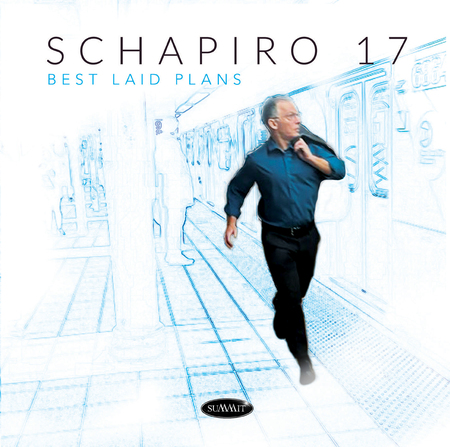
Jon Schapiro curates a moving architecture of tensions with the third recording by his Schapiro17 musical project, “Best Laid Plans.” Featuring three Schapiro originals set alongside arrangements of Herbie Hancock, Horace Silver, Scott Joplin, Sonny Rollins, and John Coltrane, the program alone signals Schapiro’s ambition to pull older materials through a modern large-ensemble imagination.
The most compelling idea running through the liner essay is Schapiro’s treatment of arrangement as composition. The ensemble material focuses on pressing back against solos, interrupting them, enlarging them, and sometimes seizing the dramatic center for itself. It suggests that the real star here is not any single improviser but the constantly changing relation between solo voice and collective mass.
That ambition is evident in the repertoire choices. Hancock’s “Chameleon” is included as a chance to rethink groove with Paul Carlon’s methodical ascent clashing with the rhythmic disruption of Eddie Allen’s trumpet. “Quicksilver,” meanwhile, is less chaotic, with the original harmony deliberately smoothed into a sparser, more pliable landscape.
The experimental approach to composition on this record is evident in the title track itself, as Schapiro explains that “Best Laid Plans” emerged after he “blew up an original that didn’t work,” salvaged the melody, and started again. The originals appear to provide the album’s backbone, with “Ugly Chic” making a bold opening statement with its sequence of solos. The album closes out with “The Uncluttered Mind,” which falls squarely in the category of straight-ahead expanded minor blues. It feels like a deliberate final clearing of the air after an album otherwise full of crosscurrents and structural feints.
The production team deserves attention too, with producer Jamie Begian and engineer Fernando Lodeiro helping Schapiro turn his compositions into complete works. The clarity of the recordings particularly stands out, as it allows the listener to hear not just the solos, but the pressure of the arrangement around them.
Best Laid Plans is a modern big-band album with unusual confidence in arrangement as drama. The strongest impression is that Schapiro is trying to revive old distinctions, such as composition versus arrangement, soloist versus ensemble, and tradition versus experiment. With a series of memorable performances this album is a record of uncommon internal motion: urbane, probing, and alive to the pleasures of friction.