
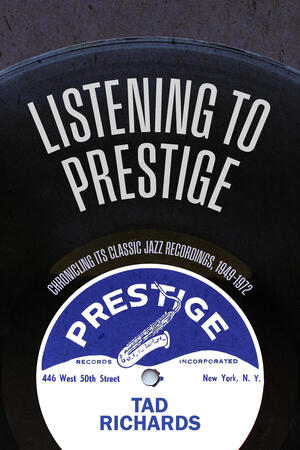
In his book “Listening to Prestige: Chronicling Its Classic Jazz Recordings, 1949–1972,” Tad Richards provides what many in the industry have called a “valentine” to one of the most foundational independent labels in post-war jazz history. Richards’ work is a deep dive into the evolution of modern jazz, viewed through the lens of a label that served as a springboard for many of its great icons’ careers.
Richards is an author and jazz enthusiast who fully immersed himself in the genre during the 1950s, a period that sparked his lifelong passion for music. His deep involvement in modern jazz is evidenced by his ten-year project, the blog “Listening to Prestige,” where he listened to and documented every single Prestige recording session in chronological order starting in 2014.
This book grew out of that exhaustive study, blending his personal collecting history with a professional’s grasp of jazz’s historical succession and the bebop era. Richards’ contribution is significant because while labels like Blue Note have been extensively documented, Prestige has remained relatively overlooked in a historical sense.
Richards begins the narrative by highlighting that Prestige and other independent labels were willing to take risks on new talent and “uncompromising expressions” of jazz that major corporate labels often ignored. A defining characteristic of the label was Bob Weinstock’s preference for “pure spontaneity” in the studio. Prestige sessions often captured the raw atmosphere of the New York jazz scene, often resembling all-out jam sessions.
One of the most interesting segments of the book is the section on technical innovation, chronicling how the shift from 78 rpm records to the 10-inch and eventually 12-inch LP changed the music itself. Richards makes the classy choice of not focusing on artists alone, and dedicates a significant segment of this book to the pivotal role of recording engineer Rudy Van Gelder, whose suburban living room studio became the site of many of the label’s most historic sessions.
Among the artists covered, Richards highlights a Mount Rushmore of Modern Jazz that started their careers at Prestige, composed of Miles Davis, Sonny Rollins, and Thelonious Monk. While all these artists moved on to bigger and better-funded records, it was Weinstock’s vision that brought them into the spotlight.
Where Richards’ work truly shines is in its treatment of the label’s later years, a period often overlooked by jazz purists. He details the 1957 arrival of Mose Allison and Yusef Lateef as a turning point where the label began to outgrow its New York bebop roots.
As the 1960s took hold, Richards chronicles the rise of “Soul Jazz,” led by a new vanguard with the likes of Jack McDuff, Richard “Groove” Holmes, and Charles Earland.
Richards builds a compelling argument that these records, often dismissed by critics, were essential to the label’s survival and reflected the shifting cultural tastes of the Black American audience.
The book concludes with the 1971 sale of the label to Fantasy Records for $3.2 million. By then, the independent distribution model was crumbling, and Weinstock recognized that the era of the small, personality-driven jazz label was ending.
Ultimately, Listening to Prestige is an essential addition to any jazz library. Tad Richards has done more than just list sessions; he has mapped the soul of a label that was willing to be messy, immediate, and profoundly human.